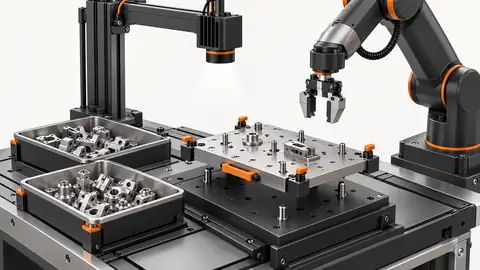
Problem and prerequisites
A lively tray is not proof of useful feeding. Optimize parts that the gripper can actually pick, not vibration amplitude alone. Use the production tray, representative parts and a stable camera view.
Prepare the test
Assume 30 parts are loaded and 12 satisfy the proposed pick rules: 12/30 = 40% visible pickability, not measured throughput. Fix the load, imaging and gripper-clearance rules before comparing recipes.
Prepare a repeatable loading method before changing vibration. Record part revision, tray identity, tray surface condition, initial loading distribution and the permitted number of parts. A clean dry sample and an oily production sample can behave differently; retain the condition that the application must actually handle. Confirm that the vision recipe recognizes only permitted orientations and that the gripper clearance reflects the physical tool. Freeze camera exposure, lighting, detection settings and robot approach while comparing feeder changes. Otherwise a change in candidate count cannot be attributed to vibration. Check the manufacturer’s allowable vibration settings and operating sequence; this tutorial provides an experimental method, not a universal amplitude or frequency setting.
Procedure
- Save baseline F01 with images before and after each vibration sequence.
- Change one allowed vibration parameter or sequence segment to create F02; stay within the manufacturer’s limits.
- Wait for settling, capture the tray and count isolated, correctly oriented candidates with gripper clearance.
- Attempt picks and record successful removal separately from visually eligible candidates.
- Repeat with the same loading method, then test low and high tray population; record video for your own test evidence.
Save F01 and capture the same stage boundaries for each run: before vibration, after settling, after detection and after actual picking. Change one documented vibration parameter or one sequence segment to make F02. Reload using the agreed method rather than comparing F02 with the depleted population left by F01. Wait for the configured settling condition before counting candidates; moving contours can look separated while remaining unpickable. Record the rejected candidate reasons where available, such as orientation or tool clearance, alongside the eligible count. Perform real picks under the reviewed robot sequence and record failed attempts separately. Keep a run identifier on every image so that a favorable frame cannot accidentally represent a different loading condition.
Illustrative test record
Illustrative assumptions, not measured Deyi performance. Replace these values with your own signed test records.
| Record | Assumed value |
|---|---|
| Sample count | 30 |
| Pickable candidates | 12 |
| Validated recipe A | F01 |
| Candidate recipe B | F02 |
Count a candidate only after checking the complete gripper clearance, allowed orientation and configured pick point. Two isolated-looking contours can still share the gripper’s swept area. For F01 and F02, record candidates before picking, attempted picks, successful picks and redistribution time separately. A higher candidate percentage with more failed picks is not an improvement. Compare repeated runs with the same loading method rather than selecting one favorable image.
Compare candidate availability and transferred-part success as separate outcomes. The illustrative 12 of 30 ratio is a snapshot of image eligibility; it does not measure parts per minute or prove that all twelve can be picked consecutively. Each pick changes the tray population and may reveal or disturb another part. Record the time spent redistributing after failed or unavailable picks, not only the best vibration interval. Review contact, overlap and remaining-part patterns in the reader-recorded video when one is collected. If no video was obtained, request that evidence during testing rather than asserting that it exists. Prefer a recipe that repeats useful outcomes across the agreed loading envelope over one that wins a single image comparison.
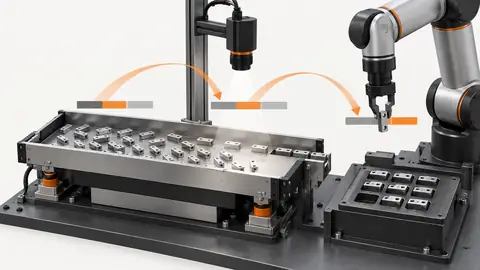
Two views of the workflow
Tune a flexible-feeder recipe with controlled trials — 1
Keep loading and imaging fixed while comparing one changed vibration setting; then verify actual picks.
- Load
- Vibrate
- Settle
- Detect
- Pick
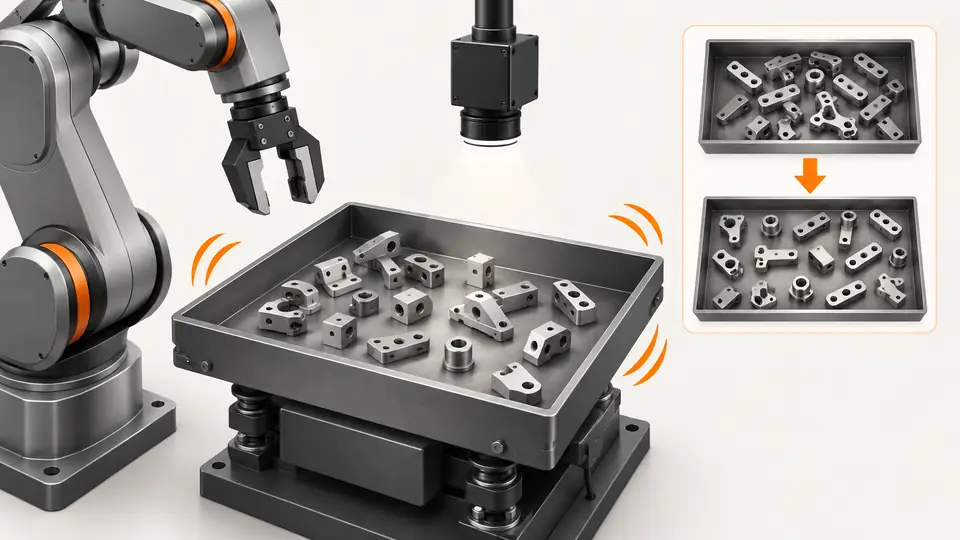
Tune a flexible-feeder recipe with controlled trials — 2
Visible candidates and successful removals are separate counts. A false candidate improves neither throughput nor reliability.
- Visible parts
- Eligible candidates
- Successful picks
Troubleshooting
- More candidates with fewer successful picks indicates bad clearance, pose or settling.
- Persistent clumps require reviewing surface, loading and vibration direction rather than raising every setting.
- A changing exposure invalidates a recipe comparison because candidate detection changes too.
Acceptance and handover
Choose a recipe only after repeatable spread and actual pick success across the specified load range. Retain settings, part lot, images and cycle time. The 40% example is a defined ratio, not a Deyi performance claim.
Set acceptance limits before testing and retain the original evidence. The examples here do not establish a supplied model’s capabilities.
Validate the chosen recipe with a fresh representative loading set not used to choose its parameters. Include the agreed low and high loading conditions, normal part variation and replenishment behavior. Confirm that the same detection and gripper rules remain active; relaxing clearance to increase the candidate count changes the problem rather than proving feeder improvement. Revert to F01 and repeat a baseline run to check whether surface changes or accumulated debris biased the comparison. Handover should contain both recipe files, parameter differences, run identifiers, candidate and pick records, and the actual loading method. Production throughput requires its own elapsed-time test including replenishment and recovery; neither a 40% candidate ratio nor a strong vibration setting establishes that throughput.
Sources and technical references
These references explain the methods and limits used in this tutorial. Example checks are guidance; production acceptance requires evidence from your own samples.
- Create new multi-feeding recipes — EYE+ 5.4Asyril
Recipe stages include candidate selection, pick point, angle, gripper conditions and vibration configuration.
Checked - Asyril AcademyAsyril
Official training covers camera setup, recipes, hand-eye calibration, communication and integration.
Checked
Component and selection references
- Flexible Feeder Selection Guide
- Flexible Feeder Robot Loading for Small Parts
- Flexible Feeders & Workstations
- Flexible Feeding & Robot Loading
- Robot Guidance Pick and Place Positioning
- Validate hand-eye calibration across the tray
- Part positioning: acceptance and motion handoff
- Part positioning: an AI-assisted pixel workflow
- Part positioning: camera and coordinate setup
- Part positioning: lighting and ROI stability
- Part positioning: locate the cause of pick offset
- Diagnose pick offsets through frames, TCP and part height