
Review parameters
Inspect supported settings and their ranges. Keep the sample and target visible while choosing the next change.
DeYiVision Vision Workbench
Bring samples, parameters and results into one industrial machine vision software workbench. Explore supported workflows with visual editing and MCP-assisted iteration.
Engineering evaluation · Windows workbench · Device-specific review
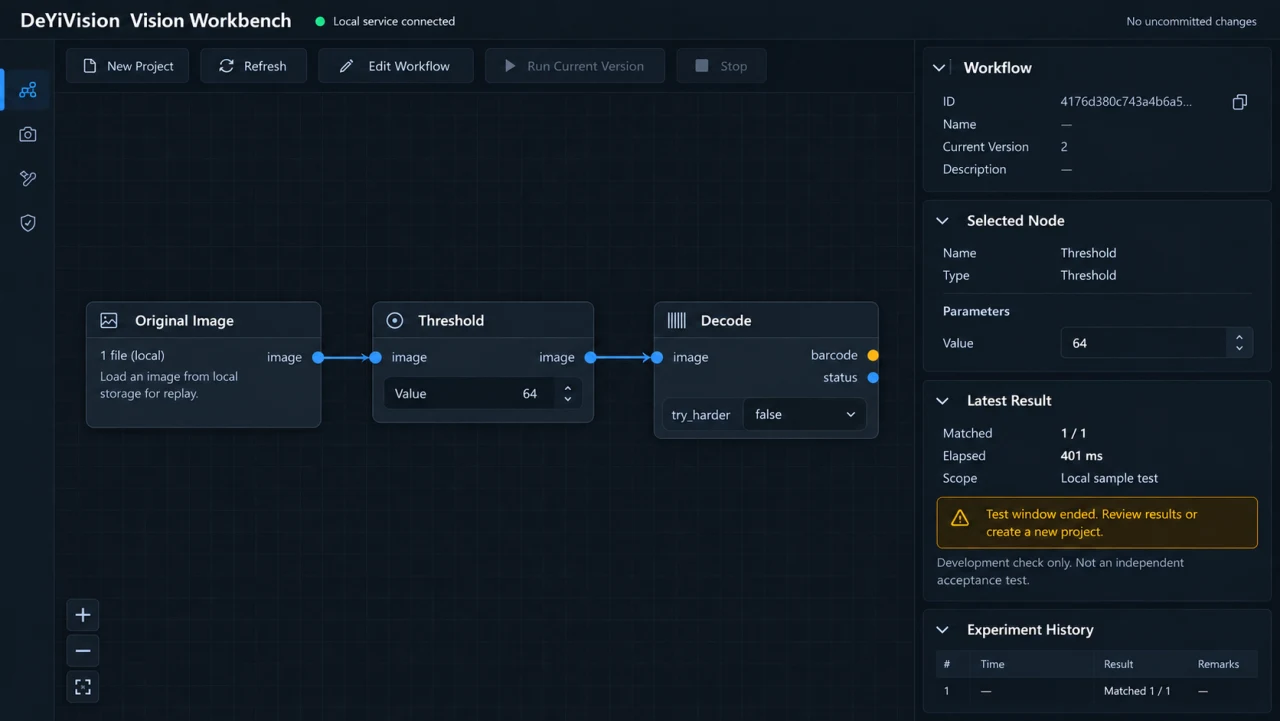
Three ways to work
Inspect supported settings and their ranges. Keep the sample and target visible while choosing the next change.
Connect supported processing nodes, edit values and run a saved revision. Compare results without losing the version that produced them.
Let an AI client inspect tools, propose a candidate and review experiment evidence. Keep engineering review in the loop.
A repeatable process
MCP (Model Context Protocol) connects an AI client to the workbench’s supported tools. Inspect a workflow, propose a candidate and review its experiment results before choosing a revision.
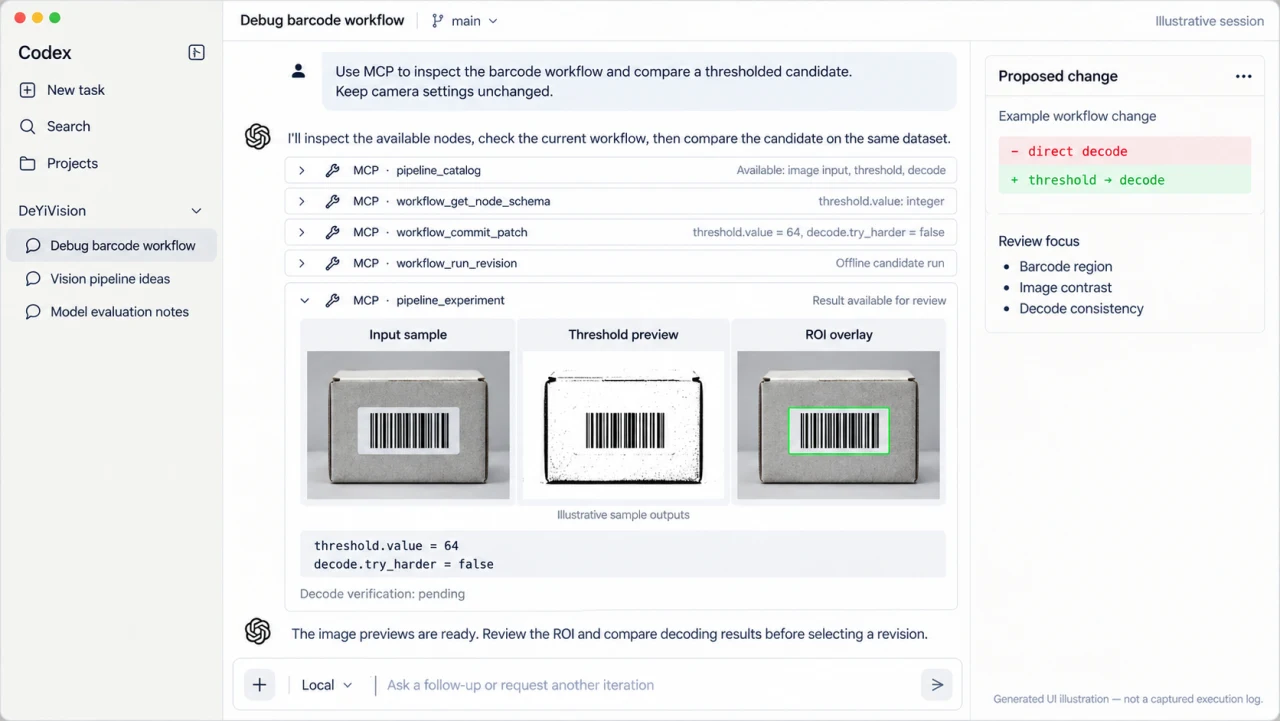
An offline run uses saved images. It does not change camera exposure or prove how a new frame will perform on your line.
Engineering interface
The engineering workbench keeps the workflow and its result together. Check which revision ran, whether the decoded content matches the expected answer and what remains unverified.
This captured engineering interface shows a small development test. It is not a production read-rate claim or an independent acceptance test.
Open the original interface capture →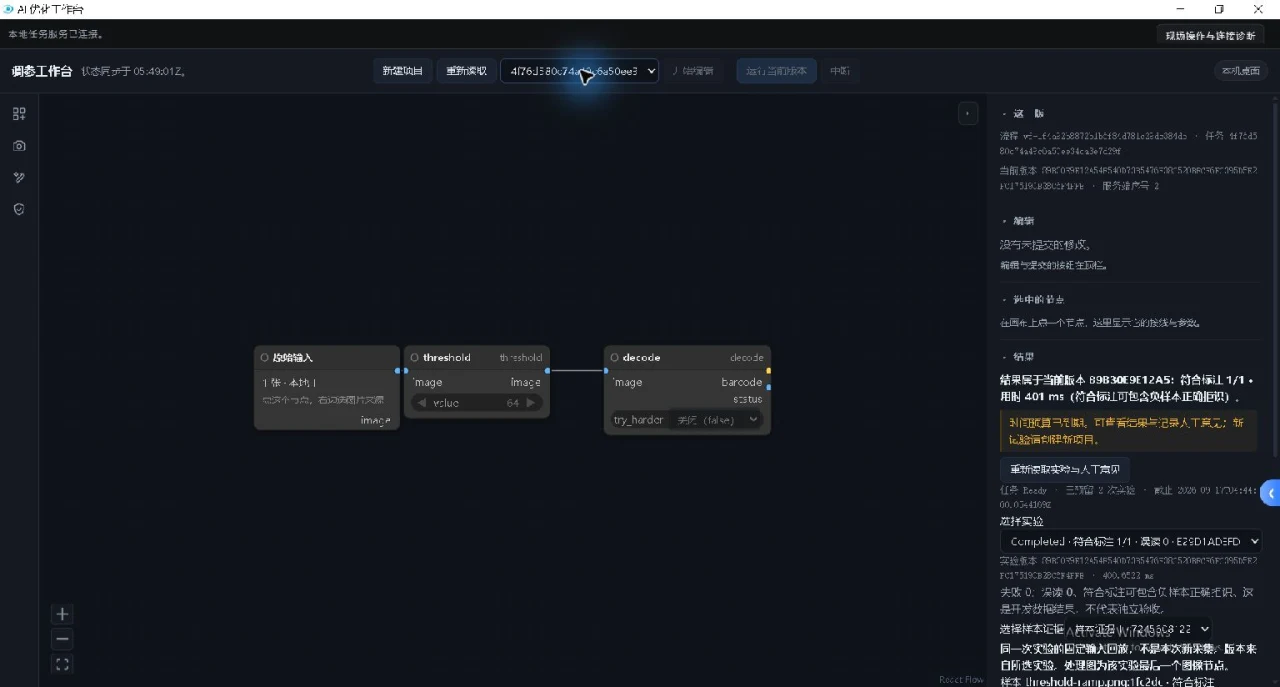
Industrial vision in practice
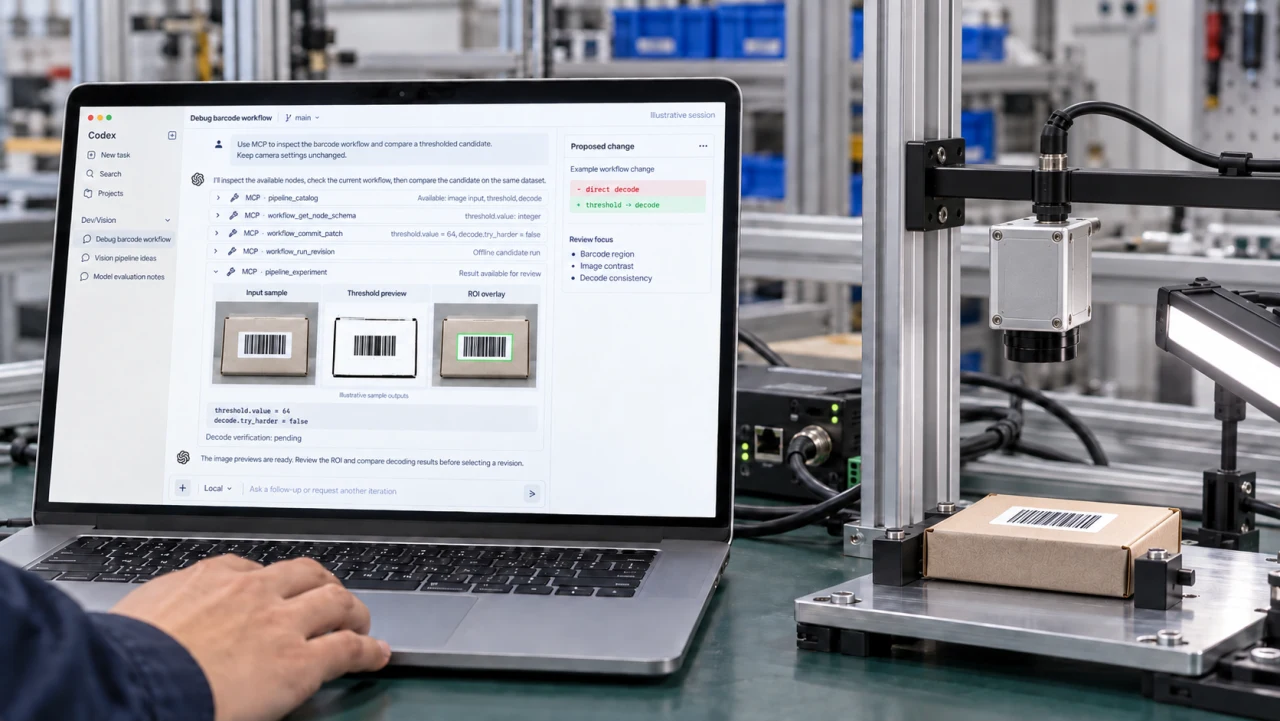
A short sequence of imaging stations, part handling and inspection views. Use it to discuss your setup; workbench compatibility is reviewed separately below.
Before your project starts
Start with the supported PC EAN-13 barcode workflow and confirmed sample images. Camera-side tuning is reviewed separately for your model, firmware, SDK and job.
OCR, DataMatrix and surface-defect templates that require unbound nodes are not included as ready-to-run PC workflows. A listed template is not proof of executable support.
Practical FAQ
Send the camera model, firmware and the job you want to improve. Compatibility and camera-side changes require a review of the specific device, SDK and job; support is not assumed from the brand or connection type alone.
Yes. Confirmed sample images can be used to evaluate supported PC processing workflows. An offline result does not verify image acquisition, production timing or performance on new camera frames.
Reading a workflow, running an offline experiment and writing camera settings are separate operations. Camera-side tuning requires the supported device workflow and its verification steps. A saved workflow revision does not mean a camera configuration has been deployed.
The workbench uses node-based editing and supports a subset of ComfyUI-style backend interfaces. This does not mean every ComfyUI node or its complete browser interface is supported.
Describe the result you need and what is going wrong. Add sample images and your camera model if available. You can start without knowing the model; engineering will identify the missing information before proposing a test.
Start with your inspection problem
Tell us what should happen and what is going wrong. We will review the supported scope, missing information and a possible next test step.