Selection Guide

Flexible Feeder Selection Guide

Choose flexible vibratory feeders and feeding workstations by part size, tray area, cycle time, vision route and robot handoff.

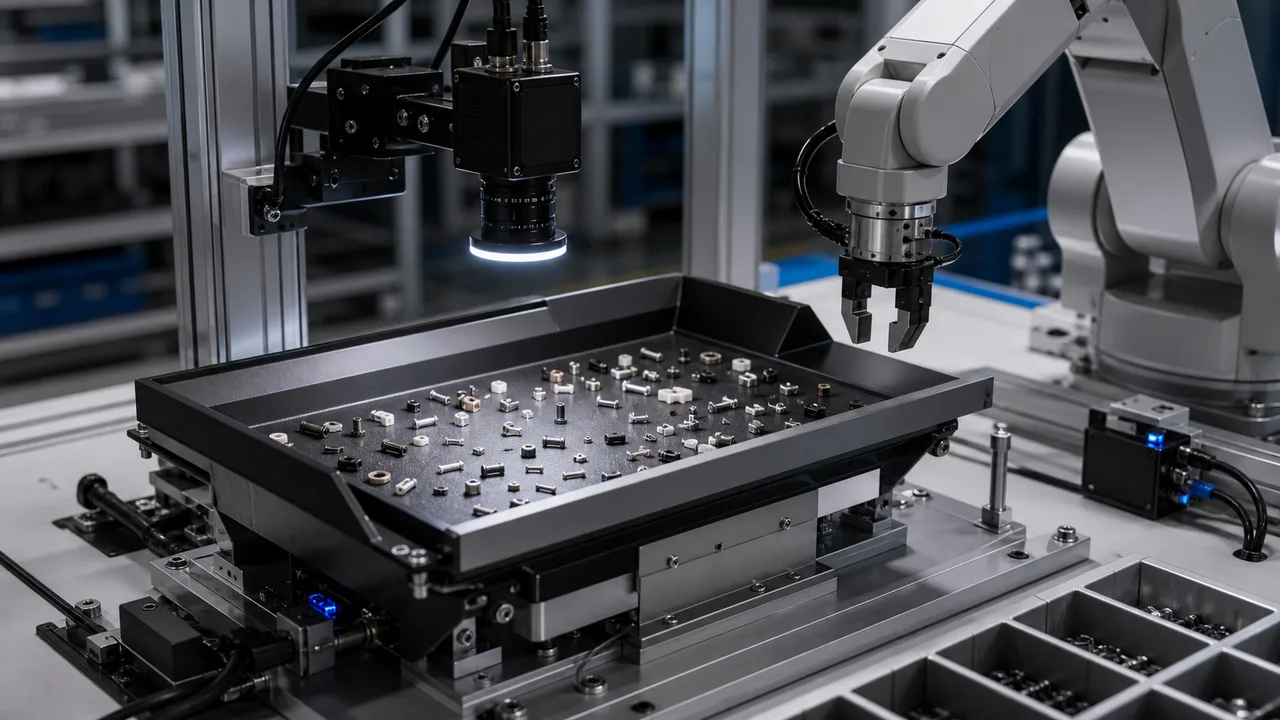
DEYI flexible feeder tray size selection photo

Direct answer

Flexible Feeder Selection Guide

Choose by 5 inputs: part size, behavior, tray area, cycle time and robot tolerance. DEYI F routes cover 89 x 120mm to 341 x 500mm trays and 0.1-100mm parts.

Quick answer

What is the short answer for flexible feeder selection guide?

Choose by 5 inputs: part size, behavior, tray area, cycle time and robot tolerance. DEYI F routes cover 89 x 120mm to 341 x 500mm trays and 0.1-100mm parts.

Quick answer

What should be confirmed before RFQ?

FL economy and FS full-view series solve different cost and field-of-view constraints.

Quick answer

What evidence should Deyi Vision review?

DTA workstation routes add 4-axis motion, storage bin, vision and robot handoff when a feeder alone is not enough.

Key takeaways

What this page should help engineering teams decide.

  • F selection edition covers 7 feeder sizes from F90 to F500.
  • FL economy and FS full-view series solve different cost and field-of-view constraints.
  • DTA workstation routes add 4-axis motion, storage bin, vision and robot handoff when a feeder alone is not enough.
Key point

Start with part behavior before tray size.

Small parts can overlap, stick, roll, flip or nest. The brochure supports POM, ESD POM, Teflon, anti-stick, anti-roll, flat-bottom, grid and profile tray routes, so material behavior decides the tray before the model number.

Key point

F series defines the main size ladder.

The F selection edition runs from MZ-F90 at 89 x 120mm and 0.1-5mm parts to MZ-F500 at 341 x 500mm and 20-100mm parts. Cycle-time classes range from 100-250ms to 200-500ms per action.

Key point

FL and FS are separate selection routes.

FL economy models reduce weight and package cost for stable applications, while FS full-view models improve pickup field of view in space-limited machines. Treat them as different routes, not simple cheaper versions.

Key point

DTA workstations reduce integration risk.

DTA routes add 4-axis motion, +/-0.15mm repeatability, AC220V / 1.2kW power, NPN I/O, USB-3 / HDMI-1 and standard storage-bin pairings. Use them when the buyer needs a deployable cell, not a feeder-only component.

Selection framework

Use this guide as a pre-RFQ decision filter, not as a part-number shortcut.

Machine vision selection is usually stable when the project starts from the inspection condition instead of a catalog model. Before requesting a quote, define what must be detected or measured, how the part moves, what surface behavior affects contrast and which factory constraint cannot change.

For flexible feeder selection guide, the engineering team should translate the requirement into testable inputs: sample images, target tolerance, line speed, field of view, working distance, mounting envelope and the current failure mode. That gives the factory enough evidence to map the request to camera, lighting, optics, reader or 3D routes.

Decision matrix

Three checks before locking the route.

01

F selection edition

Use as the main ladder from F90 to F500 when part size runs from 0.1mm to 100mm.

02

FL economy series

Use when the application is stable and cost/weight matter more than maximum configuration flexibility.

03

FS full-view series

Use when limited machine space needs a larger visual field for robot pickup.

Comparison table

Use these data points to turn the concept into an RFQ-ready decision.

Factor Practical rule RFQ impact
F selection edition Use as the main ladder from F90 to F500 when part size runs from 0.1mm to 100mm. Send part size, weight, photos, tray depth and cycle target.
FL economy series Use when the application is stable and cost/weight matter more than maximum configuration flexibility. Confirm whether the part fits FL200, FL300 or FL500 tray ranges.
FS full-view series Use when limited machine space needs a larger visual field for robot pickup. Confirm camera field of view, pickup area and whether automatic clearing is required.
Tray material and structure Use POM, ESD POM, Teflon, flat-bottom, grid or profile trays based on sticking, rolling and positioning behavior. Send real part video and surface/material notes before model lock.
DTA workstation Use when 4-axis motion, storage bin, touch panel, I/O and vision control must be delivered as one cell. Send maximum feeding size, feeding range, takt time, robot/interface and space constraints.

Common mistakes

Problems that slow down selection.

  • Selecting by model number before the inspection target is measurable.
  • Treating lighting as an accessory instead of the main contrast-control tool.
  • Ignoring fixture stability, part variation and operator maintenance workflow.

Factory handoff

What Deyi Vision reviews after receiving the project details.

The factory route review starts by checking whether the image can be made stable with lighting and fixture control. Then the camera, lens, reader or 3D sensor route is sized against speed, resolution, interface and installation constraints.

If you already have a Keyence, Cognex, Basler, OPT, LMI, Hikrobot or barcode-reader reference, include it as a benchmark. Deyi Vision uses the reference to understand the application class; final selection still depends on real samples and production limits.

Guide to RFQ

Have a real part, sample image or production constraint?

Use the guide to frame the question, then send the details so engineering can recommend a route.

Request engineering RFQ

Guide FAQ

Questions related to flexible feeder selection guide.

Ask engineering
What is a flexible vibratory feeder?

A flexible vibratory feeder spreads and reorients loose parts on a tray so a vision system and robot can locate and pick them without a fixed bowl track for every SKU.

What is the difference between F, FL and FS feeder series?

F is the main selection edition, FL is the economy route for stable applications, and FS is the full-view route for space-limited machines that need a larger pickup field of view.

When should I choose a flexible feeding workstation?

Choose a DTA-style workstation when the project needs feeder, storage bin, camera, controller, 4-axis motion, I/O and robot pickup integration as one deployable loading cell.

What information is needed for a DEYI flexible feeder RFQ?

Send part size, weight, material, part photos or video, target cycle time, tray depth, robot model, pickup method, communication route and any current feeder issue.

Catch Defects First