Purpose and operating boundary
Accept visual decisions, complete event records and physical handling separately; a passing appearance result cannot certify leak tightness or adhesive strength.
This tutorial defines an engineering evaluation, not a ready-to-run product certification. The current Deyi Vision public PC example covers an EAN-13 workflow on confirmed sample images. Native OCR and detection work in the engineering code must be checked against the installed runtime, bound models and job before use. A browser template does not prove browser execution: the planned OpenCV.js backend needs separate verification. Cloud recognition requires explicit approval of the image scope, provider, model and cost. A review archive is not an executable release package. Camera, firmware and driver compatibility require their own check. All worksheet values below are hypothetical; they are not Deyi Vision measurements or customer results.
Prepare the evidence
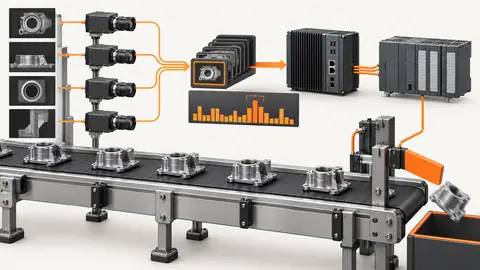
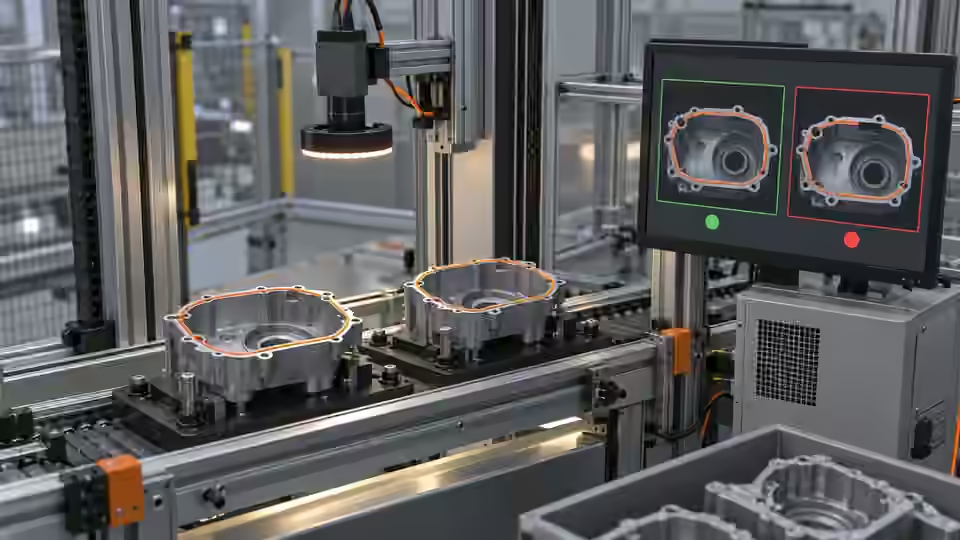
Freeze visual path definitions, material state, runtime identity and agreed Review handling. Keep any required functional seal or bond evidence as a separate acceptance workstream. Define the visible acceptance feature before building a seal or bead mask. A tamper-seal edge, a heat-seal band and an adhesive bead have different physical meanings and must not share an undeclared appearance rule. Record the reference path, permitted projection, substrate and state of the material at capture. Wet adhesive, cured material and a reflective backing can produce different boundaries without an equivalent change in joint integrity. Include a deliberately visible gap, an offset path, a plausible reflection and an obscured section as separate controls. The assigned image rule evaluates observable surface appearance only. It cannot establish airtightness, leak rate, peel strength, bond strength, cure or a hidden interface. Those claims need their own process-specific evidence. If the required interface is hidden, return insufficient evidence or choose another validated observation method; do not complete the path from an expected drawing. Write the line contract before connecting a verdict to an actuator. Define acquisition identity, recipe revision, result state, deadline, acknowledgement and the disposition of missing or late data. Exercise the handshake with outputs inhibited, then use a supervised line trial under the plant acceptance procedure. Measure from the same defined event on each run; processing time alone omits queueing, transfer and output delay. A repeated product identifier is not a unique frame identifier. Test stop, restart, reconnect and recipe change with outstanding work. Preserve the full sequence so that the part being rejected can be traced to the evidence that justified that action. Define which timestamp starts the deadline and which acknowledgement proves completion. Save queueing and communication delays beside image processing so that a fast algorithm does not conceal a late line result. Use monotonic timing for intervals and a separately documented clock mapping when devices use different clocks. Record tail delays, missing results and reconnect behavior, not only the average. A new recipe must not reinterpret results already in flight; either finish under the recorded revision or apply the agreed inhibit procedure. Keep the output sequence, product position and confirmation together. The acceptance record should distinguish correct classification from successful communication and from confirmed physical routing.
Procedure
- Use independently referenced continuous, gap, offset and hidden controls, retaining all planned events.
- Send event identity, visual verdict, validity and reason with the exact revision; reject stale or mismatched acknowledgement.
- Inject no image, unavailable runtime, duplicate delivery, late result and restart with work pending before enabling actual outputs.
- Verify the supervised physical route for the current part and keep its evidence distinct from functional joint testing.
Interpret the trial
The hypothetical budget is acquisition 8 ms, segmentation 14 ms, rules 6 ms and communication 4 ms: total 32 ms against a 100 ms deadline, leaving 68 ms. It is not measured throughput. Even a correct visual result after the deadline cannot authorize the next part, and message receipt alone is not proof of the current part disposition.
Recording worksheet
| Record | Value | Interpretation |
|---|---|---|
| Acquisition / mask / rules / communication | 8 + 14 + 6 + 4 ms | Total = 32 ms |
| Deadline | 100 ms | Margin = 68 ms; hypothetical |
T = 8 + 14 + 6 + 4 = 32 ms
M = 100 - 32 = 68 ms
Two engineering views
Two engineering views · 1
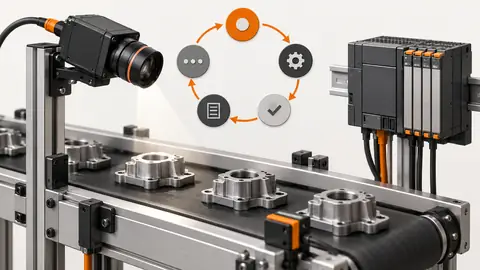
The diagram shows the order of checks. Each arrow requires recorded evidence; it does not imply an implemented automatic connection. Acquisition → Verdict → Acknowledgement → Physical route.
- Acquisition
- Verdict
- Acknowledgement
- Physical route
Two engineering views · 2
The diagram shows the order of checks. Each arrow requires recorded evidence; it does not imply an implemented automatic connection. Normal → Missing → Late → Inhibited.
- Normal
- Missing
- Late
- Inhibited
Failure diagnosis
- A complete-looking path can coexist with poor adhesion or a hidden channel; preserve the scope of the visual claim.
- Counting only completed passing images conceals unobservable and execution-failure events.
Acceptance and handover
Accept only the declared appearance scope demonstrated by independent samples, observed timing and current-event handling. Record the tested hardware and executable package; retain unresolved visibility and separate functional qualification without inventing production readiness.
Keep the source images, the expected decision, the exact revision and the complete result record together. Freeze the evaluation set before selecting the final parameters. If those answers are later used to tune the workflow, mark that set as development data and obtain a new independent acceptance set. Keep Review, NoResult, execution error and missing acquisition visible in the denominator; do not turn them into passes by filtering rows. Save a reproducible failure alongside the successful sample. The handover should identify who may change the recipe, how a prior approved revision is restored and which device output remains inhibited until acceptance. A software result alone does not establish that a moving physical part reached the correct destination.
Sources and technical references
These references explain the methods and limits used in this tutorial. Example checks are guidance; production acceptance requires evidence from your own samples.
- Deyi Vision Vision WorkbenchDeyi Vision
The public PC example is bounded EAN-13 saved-image scope; templates are not universal executable support or production acceptance.
Checked - Build a PLC–vision handshake with explicit statesDeyi Vision
Associate valid decisions, review, faults, timeout and restart with the same request/item identity.
Checked - Load-test latency from trigger to PLC decisionDeyi Vision
Observed timing and missing/late counts are distinct from hypothetical budgets and saved-image success.
Checked - Standard Test Method for Seal Strength of Flexible Barrier MaterialsASTM International
Published scope describes force-based seal-strength testing, which is separate from visible appearance. This tutorial does not claim compliance or prescribe its test implementation.
Checked
Component and selection references
- machine vision software
- Pharmaceutical Packaging Code Label Seal Inspection
- Automated Visual Inspection
- Machine Vision Systems
- Accept and integrate visible assembly verification
- Build an AI-assisted visible assembly workflow
- EAN-13 traceability: line acceptance
- EAN-13 traceability: decode and data rules
- Stable camera acquisition: buffers, timeouts and reconnection
- Accept and integrate a visible fill-level workflow
- AI-assisted workflow for a visible level proxy
- Link inspection records, images and part identifiers
- OCR labels: acceptance and PLC contract
- OCR labels: native workflow and exact match
- Accept and integrate open-package completeness checks
- Build an AI-assisted open-package completeness workflow
- Seal and bead appearance: workflow rules
- SKU color sorting: acceptance and unknown route
- SKU color sorting: typed color and SKU rules
- Surface defects: acceptance and line output
- Surface defects: bounded AI evaluation
- Version and roll back the complete vision recipe