Freeze the visible kit acceptance claim
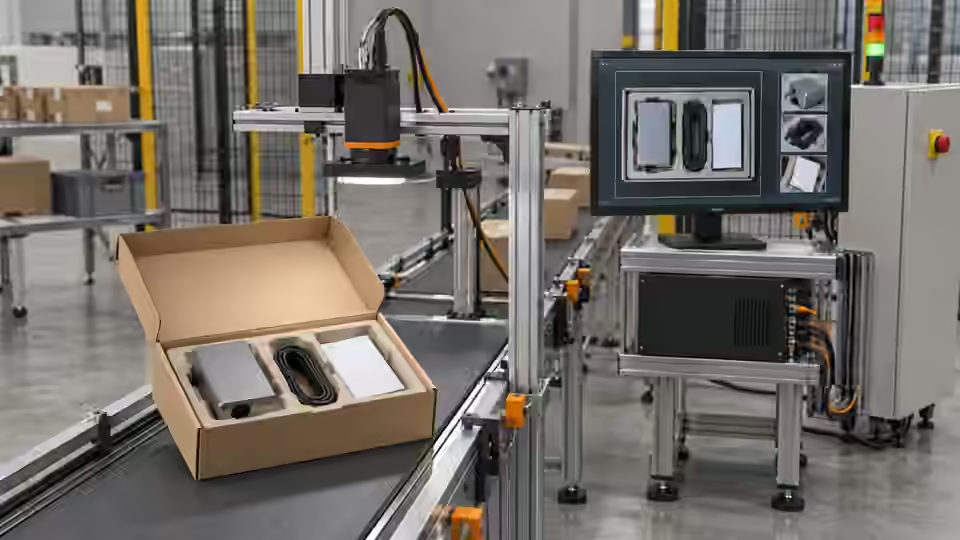
Freeze acceptance around the declared visible items and quantities of a versioned kit in an open package at the agreed event. List contents under flaps, opaque padding or a closed carton as excluded observations unless another validated method supplies their evidence. Apparent occupancy of a cavity is not automatically proof of correct SKU identity. If the workflow uses configured foreground zones, retain that identity boundary and document which substitutions it can actually distinguish. Agree presentation, material, pose and review policy before the run so an accepted image count does not become an unsupported claim that the complete shipment or concealed inventory is correct.
Reserve independent packaging groups
Reserve independently identified packages, material batches and permitted kit variations not used to choose camera, light, regions, masks or model settings. Include complete visible kits, genuine omissions, extra visible items, unfamiliar substitutes, contact, clipping and covered cases. Establish references independently of the selected workflow and declare uncertain-reference treatment. Keep repeated images of the same package associated rather than counting them as independent specimens. Do not move difficult acceptance packages into development and replace them silently. Freeze the planned groups and operating conditions, and report unavailable or unresolved groups beside the accepted scope rather than letting the denominator shrink.
Test the full decision contract
Test Pass, Fail and Review branches against explicit expectations, with execution errors, unknown states and missing outputs recorded separately. In the reviewed bounded BOM route, valid visible quantity differences fail, unknown classes require review, and invalid visibility prevents an accepted inventory decision. Verify that review takes precedence over a convenient known-label match. Confirm the actual installed contracts and retained reasons. A malformed input or unavailable result must not become an empty valid package or reuse an earlier passing output. The station's response to nonpassing evidence needs an agreed process policy; this tutorial does not prescribe a universal actuator or safety action.
Visible kit acceptance has a declared boundary
The accepted observation includes exposed item zones and retains covered contents outside its inventory claim.
- Declared open-package presentation
- Visible known item and quantity evidence
- Versioned kit definition
- Covered or closed contents outside scope
Separate synthetic rules from physical evidence
Keep synthetic configuration and rule-boundary checks separate from the acceptance of actual package images. A component exactly on a configured inclusive area limit can test comparison behavior only when the visibility prerequisites remain valid. Touching, clipped or oversized regions can still be ambiguous under the evidence contract. A successful synthetic BOM example does not validate real material contrast, item identity, lighting variation or physical capture. Retain the exact configuration and expected branch for each such test. Physical package references need their own original images and independent assessments rather than being replaced by a clean fixture illustration or generated demonstration.
# Illustrative accounting check; categories must be mutually exclusive and exhaustive.
counts = [valid_decisions, review_events, execution_failures, missing_results]
assert type(planned_events) is int and planned_events >= 0
assert all(type(value) is int and value >= 0 for value in counts)
accounted_events = sum(counts)
assert accounted_events == planned_events
# Keep specimen outcomes distinct from repeated image observations; no accuracy claim is implied.
Keep the complete planned denominator
Account for all planned events in mutually exclusive, exhaustive categories of valid decisions, review, execution failure and missing result. Count specimen outcomes separately from repeated images, and trace every category to original references and source frames. The illustrative accounting code checks completeness of recording, not classification accuracy or production performance. Do not report an accuracy figure based only on convenient valid outputs while excluding covered or failed packages. Agree application-specific limits and unresolved-case ownership before the acceptance run. Retain the full planned denominator even when a difficult material group produces review rather than a clean quantity decision.
Verify recipe and package-event handoff
Trace package identity, packing operation, source image, graph revision, kit revision, raw decision and acknowledged receiving action. Exercise startup, stop, restart, recipe change, delayed results, missing frames and cancellation in an isolated environment before enabling equipment outputs. A count matched to the wrong kit or delivered for another package has not passed integration. Check that a recipe cannot change silently between capture and evaluation, and that late responses cannot overwrite the current event. Preserve nonpassing states and review reasons through the handoff. Controller timing, acknowledgement and recovery behavior require a validated station-specific interface beyond a successful offline image replay.
Build the acceptance workbook
Package independent reference groups, kit definitions, source frames, original-coordinate zones, actual acquisition and lighting settings, foreground or model revisions, typed item evidence, validity, BOM identities, decision reasons and event handoff logs. Include original failures and unresolved ambiguity alongside accepted results. Retain baseline and candidate configurations so another engineer can reproduce both. The table marks the evidence association and its limits, rather than inventing a measured performance figure. Changes to packaging presentation, materials, classes, models, masks, BOM quantities or receiving action mapping require documented impact assessment and appropriate revalidation; an unchanged workflow name cannot preserve an altered acceptance claim.
| Evidence layer | Required association | Limit retained |
|---|---|---|
| Independent kit references | Package, material group and kit revision | Only declared visible contents |
| Raw visible item evidence and BOM | Original image, coordinates and rule identity | Unknown or invalid evidence retains review |
| Synthetic boundary check | Exact configuration and expected branch | Comparison behavior is not physical acceptance |
| Receiving action log | Package event, kit and acknowledgement | Correct count alone does not prove handoff |
Release only the demonstrated package scope
Release only the visible kit family, permitted presentation, operating conditions and interface behavior demonstrated by the agreed evidence. Historical bounded fixed-station source tests do not establish readiness of the current Windows candidate, actual camera or installed production package. Browser-local OpenCV.js is not implemented in the reviewed scope, and cloud or recognition proposals require their own supported runtime and acceptance evidence. If concealed contents remain essential, preserve an independent inventory or observation method rather than extending the visible claim. Deyi Vision can assist supported workflow investigation, but accepted open-package quantities remain a documented bounded result, not a guarantee of closed-box contents or universal packing accuracy.
From independent package to bounded release
Keep all outcomes and recipe-specific event association before accepting the demonstrated station scope.
- Freeze independent kits and limits
- Test decisions and ambiguous branches
- Verify package-specific recipe handoff
- Accept bounded scope and retain gaps
Sources and technical references
These references explain the methods and limits used in this tutorial. Example checks are guidance; production acceptance requires evidence from your own samples.
- skimage.measure APIscikit-image
Image-region measurements are evidence properties and do not certify hidden package contents.
Checked - Triggered Image AcquisitionBasler
Camera-specific acquisition readiness must be verified separately from workflow replay.
Checked - Deyi Vision Vision WorkbenchDeyi Vision
Supported saved-image evaluation does not certify the installed camera, recipe handoff or current production package.
Checked
Component and selection references
- machine vision software
- Machine Vision Acceptance Test Checklist
- Automated Visual Inspection
- EAN-13 traceability: line acceptance
- EAN-13 traceability: decode and data rules
- Stable camera acquisition: buffers, timeouts and reconnection
- Accept and integrate a visible fill-level workflow
- AI-assisted workflow for a visible level proxy
- Link inspection records, images and part identifiers
- OCR labels: acceptance and PLC contract
- OCR labels: native workflow and exact match
- Build an AI-assisted open-package completeness workflow
- Build a PLC–vision handshake with explicit states
- Seal and bead appearance: line acceptance
- Seal and bead appearance: workflow rules
- SKU color sorting: acceptance and unknown route
- SKU color sorting: typed color and SKU rules
- Surface defects: acceptance and line output
- Surface defects: bounded AI evaluation
- Load-test latency from trigger to PLC decision
- Version and roll back the complete vision recipe