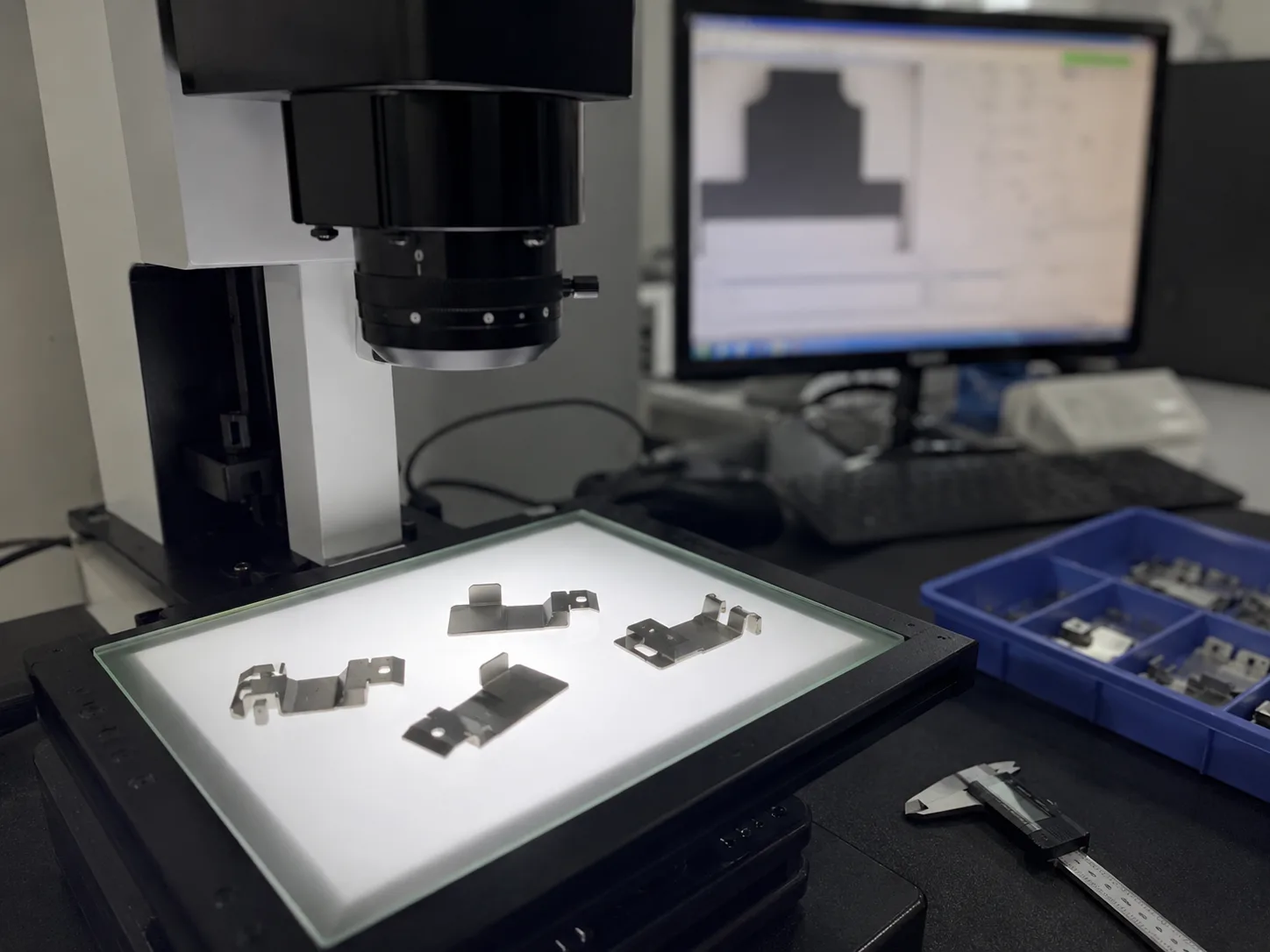
Fast dimensional check and batch-report route
Best used when manual gauges are too slow or inconsistent for small stamped, machined or molded parts.
Application selection example
Application route for fast dimensional checks on stamped, machined or molded parts using instant measuring systems. This in-house example proposes 3 acceptance checks and 4 RFQ inputs. It does not report completed customer testing or achieved performance.
Best used when manual gauges are too slow or inconsistent for small stamped, machined or molded parts.
Small parts need fast dimensional verification without slow manual measurement or inconsistent operator positioning.
Use an instant measuring system or calibrated camera-lens-lighting route based on part size, tolerance, batch inspection workflow and reporting needs.
Tolerance table confirmed before feature setup
Case decision frame
Worked examples explain the problem, assumptions, component candidates and evidence a project needs. Use these four fields to prepare a test plan for your own application.
Small parts need fast dimensional verification without slow manual measurement or inconsistent operator positioning.
Tolerance table confirmed before feature setup Repeatability checked across operator placement variation
Instant measuring system + Telecentric lens route + Backlight stage + Measurement report template
Part drawing, Tolerance table, Sample photos
Inspection workflow
The right product family depends on measurable samples, line conditions and acceptance criteria. Use this workflow to move from application idea to testable project evidence.
Example boundary
These routes show how a selection decision is reached and what is checked before acceptance. Numeric values and planning windows are example targets, not achieved results or promised lead times. These are not audited performance figures, not a customer reference list, and not a claim that any particular buyer ran this route.
Not applicable. These routes are illustrative — worked examples of how a selection decision is reached, written in house. No engagement, buyer or site sits behind any of them, so there is no party whose permission could be sought. This is not a record of consent obtained; it is a record that consent has no subject here.
Application visuals are illustrative and are not offered as photographs of a customer installation. Numeric checks and planning windows are example targets, not measured outcomes or promised lead times.
Related product families
Flash measurement and image-dimension measurement systems for fast dimensional inspection and metrology checks.
Product routeTelecentric optical routes for precision measurement, low-distortion edge capture and repeatable gauge-style inspection.
Product routeRing, bar, coaxial, dome, backlight, dark-field and line-light routes matched to defect contrast, edge clarity and part surface behavior.
Product routeFA lenses, C-mount lenses, line-scan lenses, large-format lenses, low-distortion lenses, telecentric lenses and custom optics for inspection cells.
Related solution and selection pages
Use calibrated lenses, lighting and cameras to stabilize measurement under production conditions.
ResourceLearn what telecentric lenses do, when they improve measurement repeatability and when regular machine vision lenses are enough.
ResourceSelect machine vision lenses by field of view, sensor size, working distance, aperture, distortion, resolution and whether the task needs telecentric measurement stability.
ResourceCompare telecentric and regular machine vision lenses by perspective error, measurement tolerance, working distance, field of view and budget tradeoff.
ResourceDecide when telecentric optics are justified by measurement tolerance, part height variation and fixture repeatability.
Application RFQ
Send sample images, line speed, tolerance and the current failure mode. We will map the application to camera, lighting, lens, reader, 3D or smart camera routes.
Request engineering RFQ| # | Proposed acceptance check to validate |
|---|---|
| 1 | Tolerance table confirmed before feature setup |
| 2 | Repeatability checked across operator placement variation |
| 3 | Batch report format agreed before delivery |
Application FAQ
No. This is an in-house application selection example for stamped and machined part measurement. No customer engagement, buyer or site sits behind it. The component route, sample requirements and numeric acceptance targets are proposals to validate, not achieved results.
Send part drawing, tolerance table, sample photos, report-format requirement. Include good and bad samples whenever possible so engineering can test the route before recommending hardware.
Instant Measuring Systems, Telecentric Lenses, Machine Vision Lighting are the first product families to review, but the final route depends on sample images, speed, tolerance and installation space.
Send part photos or drawings, target defect or measurement goal, field of view, working distance, line speed, accuracy target, lighting limits and any current camera, lens, light, barcode reader or competitor model.
Use 2D when contrast, edges, labels or position are enough to judge the part. Use 3D when height, profile, gap, volume, weld shape or surface geometry decides pass or fail.
Start from the defect and material surface instead of the camera model. Backlight helps edge measurement, coaxial and dome lighting help reflective surfaces, and bar or ring lighting often works for general presence and defect checks.