Selection Guides

Machine Vision Lens Selection Guide

Select machine vision lenses by field of view, sensor size, working distance, aperture, distortion, resolution and whether the task needs telecentric measurement stability.

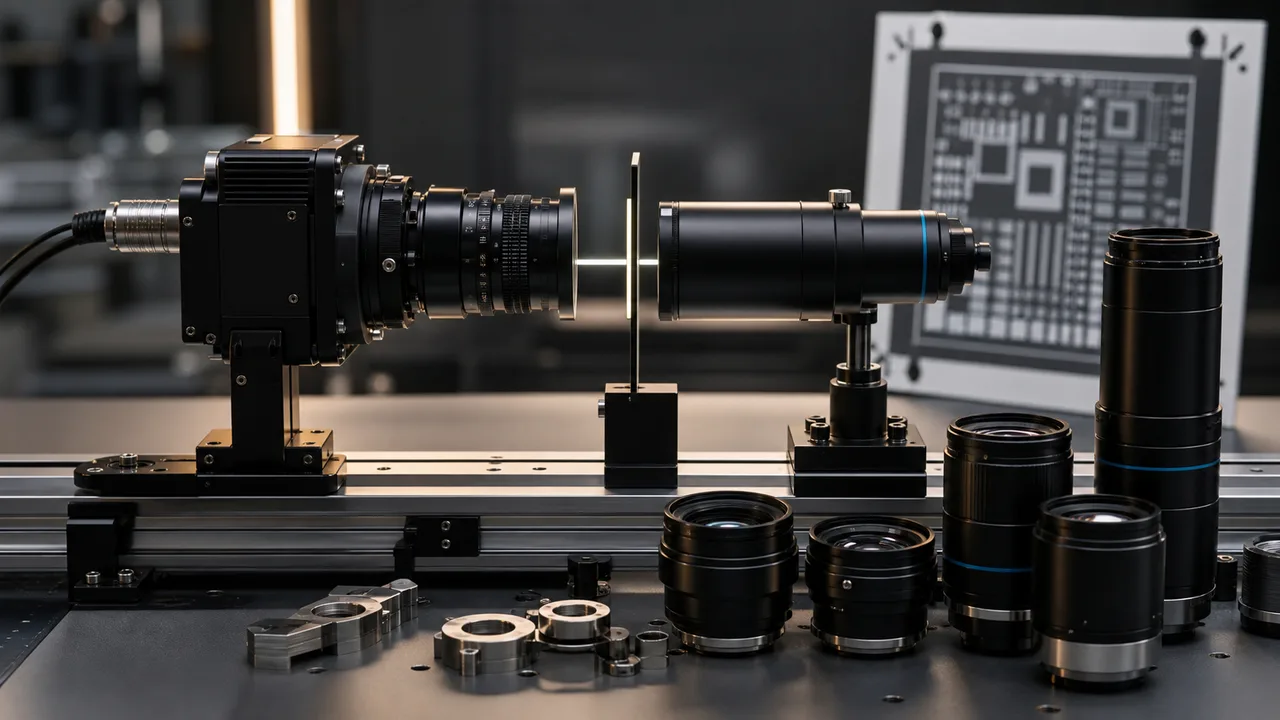
Machine vision lens selection optical bench with industrial camera and calibration target

Direct answer

Machine Vision Lens Selection Guide

Select a machine vision lens from field of view, sensor size and working distance first. Then check distortion, aperture, depth of field, sensor coverage and whether a telecentric lens is required for measurement repeatability.

Where this matters

Start with the inspection condition.

A lens is correct only when it covers the sensor and FOV, resolves the smallest feature, fits the working distance and keeps distortion within the inspection tolerance.

Why projects fail

Confirm the limits that change hardware.

Working distance often limits lens choice and lighting placement.

RFQ preparation

Send enough context for a real review.

Measurement tasks need stricter distortion control and may need telecentric optics.

What engineering should check

What this page should help teams decide.

  • Object size and sensor size must be reviewed together.
  • Working distance often limits lens choice and lighting placement.
  • Measurement tasks need stricter distortion control and may need telecentric optics.
Practical note

Calculate field of view before choosing focal length.

The lens should be selected from the required object size, sensor size and working distance. If the FOV is wrong, software scaling cannot recover missing pixels or clipped part edges.

Practical note

Check sensor coverage and corner performance.

A lens must cover the camera sensor format without unacceptable vignetting or edge softness. Large sensors, high resolution and wide FOV requirements make this check more important.

Practical note

Treat working distance as an optical and mechanical constraint.

Working distance affects focal length, depth of field, light placement and fixture access. A lens that fits the image may still fail if the machine cannot mount the camera, light and part holder repeatably.

Practical note

Use telecentric optics when perspective error changes the result.

Presence checks may tolerate a standard lens. Gauge-style measurement, edge position and strict dimensional checks often need low distortion or telecentric optics to reduce size change from part height variation.

How to test before buying

Use this guide as a pre-RFQ decision filter, not as a part-number shortcut.

Machine vision selection is usually stable when the project starts from the inspection condition instead of a catalog model. Before requesting a quote, define what must be detected or measured, how the part moves, what surface behavior affects contrast and which factory constraint cannot change.

Use this guide to translate the requirement into testable inputs: sample images, target tolerance, line speed, field of view, working distance, mounting envelope and the current failure mode. That gives the factory enough evidence to map the request to camera, lighting, optics, reader or 3D routes.
Decision checks

Three checks before locking the route.

01

Standard C-mount lens

Use for many presence, defect and positioning tasks when distortion tolerance is loose.

02

Low-distortion lens

Use when measurement or edge location needs better geometric stability but full telecentric cost is not justified.

03

Telecentric lens

Use when perspective error from height variation can change the measured size or edge position.

Decision table

Use these data points to turn the concept into an RFQ-ready decision.

Factor Practical rule RFQ impact
Standard C-mount lens Use for many presence, defect and positioning tasks when distortion tolerance is loose. Send FOV, working distance, sensor size and smallest feature.
Low-distortion lens Use when measurement or edge location needs better geometric stability but full telecentric cost is not justified. Send tolerance, calibration plan and required repeatability.
Telecentric lens Use when perspective error from height variation can change the measured size or edge position. Send object size, sensor size, working distance and part height variation.
Line-scan lens Use when wide continuous material needs edge-to-edge resolution and uniform illumination. Send web width, line rate, sensor length and line-light plan.

Application proof

Related delivery routes that make this selection decision concrete.

View all cases

Common mistakes

Problems that slow down selection.

  • Selecting by model number before the inspection target is measurable.
  • Treating lighting as an accessory instead of the main contrast-control tool.
  • Ignoring fixture stability, part variation and operator maintenance workflow.

Factory handoff

What Deyi Vision reviews after receiving the project details.

The factory route review starts by checking whether the image can be made stable with lighting and fixture control. Then the camera, lens, reader or 3D sensor route is sized against speed, resolution, interface and installation constraints.

If you already have a Keyence, Cognex, Basler, OPT, LMI, Hikrobot or barcode-reader reference, include it as a reference model. Deyi Vision uses it to understand the application class; final selection still depends on real samples and production limits.

Guide to RFQ

Have a real part, sample image or production constraint?

Use the guide to frame the question, then send the details so engineering can recommend a route.

Request engineering RFQ

Guide FAQ

Questions related to machine vision lens selection guide.

Ask engineering
How do I choose a machine vision lens?

Start with field of view, sensor size and working distance, then check focal length, distortion, aperture, depth of field, sensor coverage and resolution.

When do I need a telecentric lens?

Use a telecentric lens when measurement accuracy or edge position changes if the part height, distance or position varies within the fixture.

What should I send for a lens recommendation?

Send object size, FOV, working distance, sensor size, camera model, smallest feature, tolerance, part height variation, lighting route and mounting limits.

Contact

Direct RFQ contact

Talk to engineering about the inspection problem.

Send sample images, competitor model, FOV, working distance and line speed before model selection.

Target: selection brief within 24h
Send sample images