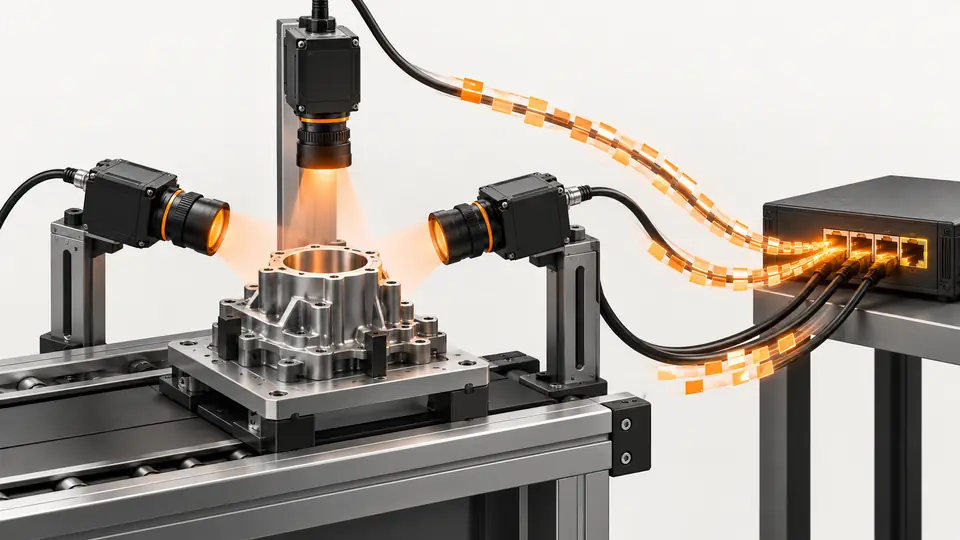
What the test resolves
Simultaneous exposure and simultaneous delivery are different requirements. Validate exposure alignment while independently testing whether burst traffic overwhelms the shared link.
This is a vendor-neutral commissioning method. Check the exact camera, lens, sensor or controller manual before changing settings. The numerical worksheet is hypothetical, not a Deyi Vision measurement or a product specification.
Operating prerequisites
Use a common hardware trigger or documented scheduled acquisition. If PTP is used, confirm support and clock stability over time; a locked clock alone does not prove aligned exposures.
Define whether the inspection needs aligned exposure, aligned timestamps or only images associated with the same part. These requirements are different. Establish support for the proposed synchronization method in every camera and network component. A PTP lock indicator alone does not verify exposure alignment. For this test, keep each camera's acquisition sequence identifiable and preserve a path for identifying a group with a missing or repeated member.
Bench and records
Prepare a shared flashing target or documented timing outputs, per-camera IDs/timestamps and network counters. Record topology, packet pacing, frame transmission delays and application queue depth.
Prepare a group record containing part or cycle ID, camera ID, frame ID, exposure settings, trigger method, timestamp clock definition and complete-image status. Document shared links and receiver queues. Provide a common observable event, such as a properly controlled optical target, or documented timing outputs measured on a common instrument. Record how the observable event relates to exposure; software arrival times are not substitutes for that relationship.
Run the test
- Verify all camera clocks or common input signals before collecting images.
- Acquire 1000 synchronized groups and measure exposure skew with the optical target or outputs.
- Run every camera at intended payload and burst rate; log incomplete frames and queue growth.
- If exposure must remain simultaneous, stagger transmission only with supported controls; repeat after restart and a clock-master change.
Verify each camera independently before starting grouped acquisition. Then acquire the planned groups and check that every group contains exactly the intended camera members. Measure exposure alignment using the common event, while logging transfer completion and queue growth separately. Introduce only supported transmission staggering if bursts overload the receiver; retain the exposure test while changing transport timing so improved reception cannot hide a new synchronization error.
Hypothetical worksheet
Hypothetically four cameras send 2 MB each at 10 fps: average payload is 80 MB/s, but each group produces an 8 MB burst. At an assumed usable 100 MB/s, draining one burst takes at least 80 ms before overhead.
aggregate_payload = cameras * bytes_per_frame * fps
4 * 2 MB * 10 = 80 MB/s
burst_drain_time >= 8 MB / 100 MB/s = 80 ms
clock_offset != exposure_skew != delivery_skew| Quantity | Hypothetical value | Meaning |
|---|---|---|
| Average payload | 80 MB/s | Four cameras at 10 fps |
| Data per group | 8 MB | Four 2 MB frames |
| Minimum drain time | 80 ms | Assumed usable link, before overhead |
The average payload calculation answers long-term loading, whereas the burst drain calculation describes a transient shared-link demand. The assumed usable bandwidth must be measured or justified for the actual path. If another burst begins before the previous one drains, queues can grow despite an acceptable average. Include protocol overhead and receiver behavior when interpreting the hypothetical lower bound; the calculated drain time is not a camera timeout setting.
Test sequence
Test sequence
Align exposure events while distributing image transmission over a separate interval.
- Common event
- Exposure
- Transfer slots
- Delivery
Interpret the evidence
Interpret the evidence
Verify synchronization first, then load the network and check queues; the two checks answer different questions.
- Clock check
- Exposure skew
- Burst load
- Queue check
Use the diagram to maintain separate evidence for exposure and delivery. Synchronized cameras may expose together but finish transmitting at different times. Conversely, images arriving together may have been exposed at different times. Plot the observed alignment and transfer completion by group identifier, keeping groups with incomplete members visible. A stable mean is insufficient when an occasional alignment excursion can invalidate a measurement of the moving part.
Troubleshooting
- Good average bandwidth with losses at each trigger suggests burst contention.
- Similar receive timestamps do not prove exposure synchronization; differing clocks can also make timestamp comparisons invalid.
If only grouped acquisition fails, compare receiver statistics with the independent-camera baseline and inspect shared bottlenecks. If timestamps drift, record synchronization state and offsets over the run rather than checking a single startup value. If a camera appears twice in one group, review cycle association before changing network settings. After any reconnect, verify group identifiers and clock state again; a clean link does not prove a clean resumption of synchronized acquisition.
Acceptance and handoff
Specify independent limits for exposure skew, frame completeness and delivery deadline. Require stable clocks and bounded queues during the agreed worst burst pattern; record reconvergence behavior after clock changes.
Archive the raw files, settings, sample identifiers and decision limits together. Discuss the documented requirements with Deyi Vision using the related product and preparation guides below.
Release only when fresh groups satisfy both the agreed exposure-alignment requirement and the complete-delivery requirement under the intended host workload. Include the most demanding image format, trigger pattern and shared traffic within the declared envelope. Verify that a missing camera or incomplete group produces an explicit invalid inspection result. Archive the group ledger, synchronization observations and final transport settings so later bandwidth or camera changes trigger a focused revalidation.
Sources and technical references
These references explain the methods and limits used in this tutorial. Example checks are guidance; production acceptance requires evidence from your own samples.
- Precision Time ProtocolBasler
Clock synchronization must be checked over a time window and depends on camera and network support.
Checked - Network-Related ParametersBasler
Packet size, inter-packet delay and frame transmission delay affect network load, separately from exposure timing.
Checked
Component and selection references
- Industrial Camera Interface Guide
- Machine Vision System Components
- Industrial 2D Cameras
- Industrial Camera for Machine Vision
- Industrial Camera vs Regular Camera
- GigE vs USB3 Industrial Camera
- PCB Connector Pin Presence Inspection
- Basler Camera Selection
- Allied Vision Camera Selection
- Hikrobot Machine Vision Alternative
- IDS Imaging Camera Selection
- Test gain, bit depth and low-contrast noise
- Diagnose lost GigE packets without masking the fault
- Measure hardware-trigger delay and jitter
- OCR labels: camera and character sampling
- Seal and bead appearance: camera setup
- SKU color sorting: acquire repeatable color
- Surface defects: camera sampling and motion