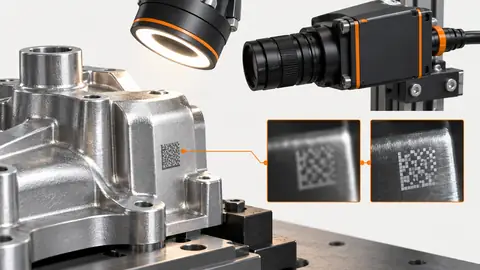
Problem and prerequisites
A code that one reader decodes is not automatically a verified mark. First decide whether the requirement is reliable reading at your station or a documented grade under a specified verification method.
Prepare the test
Prepare the actual code type, marking process and worst acceptable surfaces. For grading, obtain the verifier configuration, calibration procedure and applicable method from its manufacturer; a reader diagnostic score is a different record.
Start with the requirement expressed by the customer or receiving process. “Readable on this line” asks whether the installed reader can recover the expected data under the operating conditions. “Meets the specified quality grade” asks for a controlled verification measurement against a named specification. Write those as separate acceptance statements and identify who owns each one. Preserve the sample’s code type, printing or marking method, material and revision. Before selecting a verifier, confirm the applicable specification and measurement configuration with the responsible quality team. A reflective direct mark and a printed label cannot be assumed to use identical measurement conditions merely because both contain a two-dimensional code.
Procedure
- Write separate acceptance criteria for production reading and grading.
- Read the same labeled sample set at the intended distance, angle and line speed.
- Retain each decoded value, failed trigger and diagnostic image; the illustrative reading rate is 98/100 = 98%.
- Where grading is required, measure the same samples using the specified calibrated verifier and retain its complete report.
- Compare results by sample identifier; never convert a reading rate into a verification grade.
For the process test, freeze the production reader settings and arrange representative positions, orientations and operating speeds. Do not improve the result by removing difficult parts from the test set. Record the expected payload for every sample independently of the measured result, then classify correct reads, incorrect reads and no reads separately. A decoded string with the wrong contents is not a successful process result. If retries are allowed in production, record the first attempt and the eventual disposition separately, including time consumed by retries. Otherwise the final read percentage conceals the line’s exposure to delays. Keep the two failed samples from the illustrative run rather than replacing them with easier labels.
Illustrative test record
Illustrative assumptions, not measured Deyi performance. Replace these values with your own signed test records.
| Record | Assumed value |
|---|---|
| Sample count | 100 |
| Successful results | 98 |
| Failed results | 2 |
| Recipe version | R1 |
In the assumed 100-trigger run, 98 decoded results and two failures give a 98% process read rate only when all 100 intended parts remain in the denominator. Keep both failures for investigation. A quality grade requires the appropriate verifier, its configured standard, aperture, illumination and calibration record. Record those conditions separately; a decoder confidence score or a successful retry cannot be relabeled as a verification grade.
For verification, follow the selected verifier’s documented setup and calibration sequence, including the conditions required by the specified method. Store the reported result with the standard, configuration, instrument identity, calibration status and sample identity. Do not invent a grade from camera contrast, decoder confidence or operator judgment. A production reader may still read a poor-quality mark under favorable conditions, while a good mark may fail on a poorly configured production station. Pair the process record and the verification report by sample identity so that these two questions can be investigated together. The supplied-model feature list must be checked independently; this tutorial does not establish that an ordinary reader is a verifier.
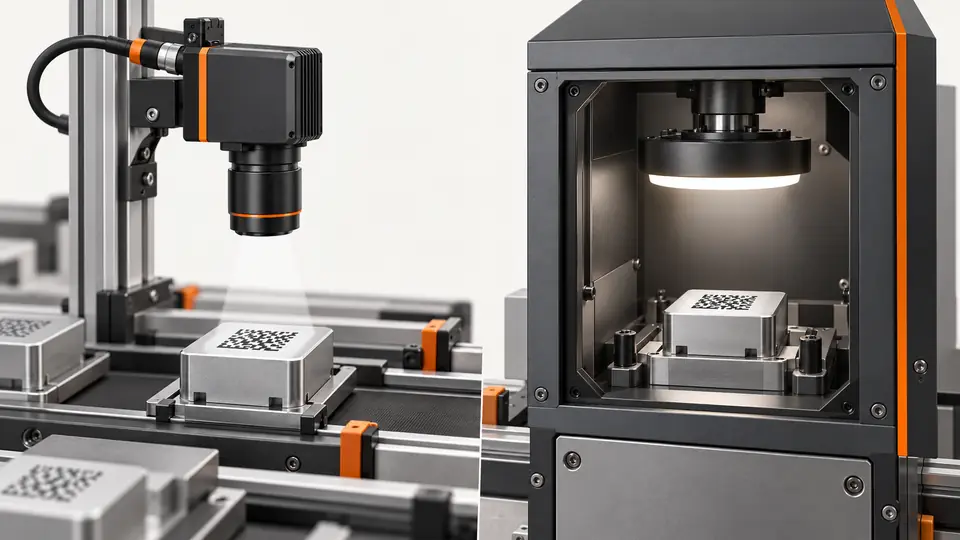
Two views of the workflow
Decoding versus barcode verification: design the right test — 1
The same sample identifier connects two tests, but each test retains its own setup and result.
- Sample
- Reader test
- Verifier test
- Reports
Decoding versus barcode verification: design the right test — 2
Decoding supplies a value or a failed read. Verification supplies a report under a defined method; the outputs are not interchangeable.
- Decoded value
- Reading rate
- Verification report
Troubleshooting
- A readable mark with an unacceptable grade needs marking-process investigation, not a fabricated reader grade.
- A good verification report with station failures requires checking motion, glare and presentation.
- Mixed code types or changed lighting require reviewing the verification setup before combining reports.
Acceptance and handover
Accept reading and verification independently against the agreed requirements. Record code type, instrument, configuration and calibration status. The assumed 98% reading rate above demonstrates arithmetic only and is not a recommended acceptance threshold.
Set acceptance limits before testing and retain the original evidence. The examples here do not establish a supplied model’s capabilities.
Handover should include a matrix showing each agreed requirement, its measurement method and its decision owner. Demonstrate a case that decodes but has an unacceptable verification result, when suitable reference samples are available, and a process no-read with its complete evidence. If such samples are unavailable, list the missing verification demonstration rather than claiming it was performed. Review exclusions, retries and wrong-content results with production and quality before approving the report. Keep verification failures distinct from reader setup failures, because changing a reader parameter cannot authorize a mark that fails the receiving quality requirement. Set the actual thresholds in the project specification; the illustrative 98% value is not a recommendation.
Sources and technical references
These references explain the methods and limits used in this tutorial. Example checks are guidance; production acceptance requires evidence from your own samples.
- Introduction to Barcode VerificationCognex
Distinction between decoding, process quality metrics and barcode verification.
Checked - DataMan 360 Reference ManualCognex
Product-specific acquisition, trigger modes, image filtering and multi-code behavior; used as a principle reference, not a Deyi specification.
Checked
Component and selection references
- Industrial Code Reader Selection Guide
- Machine Vision Acceptance Test Checklist
- Industrial Barcode Readers
- Barcode & Traceability
- Industrial Barcode Reader Selection Guide
- What Is DPM Barcode Reading?
- DPM Code Reading on Reflective Metal Parts
- Packaging Label and Barcode Inspection System
- Packaging Label and Barcode Traceability
- Direct Part Mark Code Reading on Metal Parts
- Cognex DataMan Alternative
- Datalogic Barcode Reader Alternative
- Omron Microscan Barcode Alternative
- Zebra Fixed Scanner Alternative
- Logistics Barcode Sorting
- Printing and Label Inspection
- EAN-13 traceability: decode and data rules
- EAN-13 traceability: camera sampling
- EAN-13 traceability: lighting and quiet zones
- EAN-13 traceability: duplicates and missing reads
- Track barcode results to the correct conveyor reject
- Multiple codes: region rules and duplicate-read control
- Check OCR text against barcode and batch data