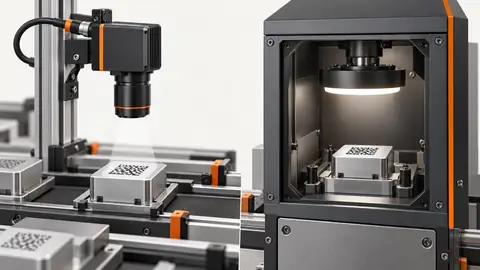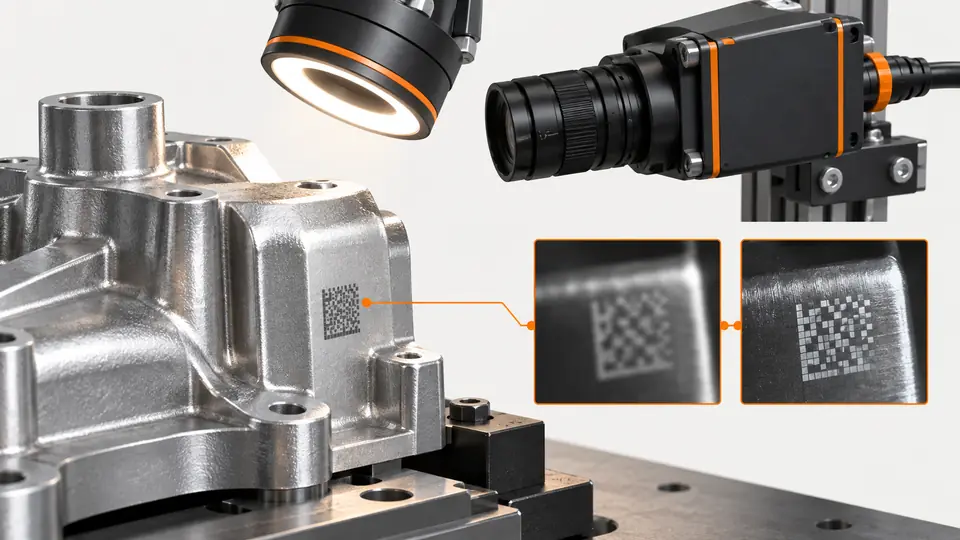
Problem and prerequisites
An unreadable result alone cannot distinguish a missing code, glare, blur or an incomplete transfer. Start with a reader that can export diagnostic images, a repeatable trigger and representative poor marks. Confirm the supported logging options in its manual.
Prepare the test
Reserve storage outside the acquisition loop. Define a unique trigger identifier independently of decoded text, so a failed read still has a usable key. Record exposure, illumination, recipe version and the original image.
Define what counts as an intended part trigger before collecting a read rate. A sensor can also detect an empty carrier or a double presentation; keep those events, but assign an explicit disposition instead of changing the denominator afterward. Use a stable fixture and retain the same difficult sample through the comparison. Mark its orientation and record working distance, region of interest, exposure and illumination setting. Obtain an image through the reader’s documented export mechanism and confirm whether it is raw, processed or a diagnostic preview. A preview that was resized or filtered can help an operator, but it must not silently replace the original evidence used to judge blur or clipping.
Procedure
- Capture a known readable part and verify that its image and result share the same trigger identifier.
- Add one error at a time - empty field, tilted mark, motion, low illumination.
- Save the original image before filtering, plus the decoding result and acquisition status.
- Classify each event as no image, no candidate or candidate not decoded; do not infer the cause from a single status code.
- Change one imaging condition and repeat the same marked parts; retain both runs.
Establish the event identifier at the trigger boundary, then carry it through acquisition, decoding, output and saving. Observe both the camera or reader completion and the application’s received result; they are different boundaries. For the baseline, confirm that the mark lies wholly inside the image and that the saved frame belongs to the same event. Introduce one fault at a time while preserving the baseline settings. For motion, retain a stationary image of the same mark for comparison. For reduced illumination, distinguish darker but complete frames from frames that never arrived. Do not label every absent image as a missing code. If the device only reports a single no-read status, add the available image and acquisition evidence to the application log without inventing a device-specific reason code.
Illustrative test record
Illustrative assumptions, not measured Deyi performance. Replace these values with your own signed test records.
| Record | Assumed value |
|---|---|
| Trigger identifier | T042 |
| Part identifier | P1042 |
| Exposure | 0.8 ms |
| Reserved diagnostic image budget | 2 GB |
For a controlled three-trigger example, create T041, T042 and T043 before decoding. If T042 has a complete image but an undecodable mark, retain its image and classify it as a decoding failure. If T043 has no image, retain the trigger event and acquisition fault. A missing stored image must never turn either event into a successful read; reconcile the three triggers against three terminal records.
The useful record is a chain of evidence, not a folder of unidentified failure images. Retain the event identifier, expected part identity if available, timestamps, raw result, acquisition state, recipe revision and save state. Use pending, saved and failed states for image storage so that a delayed writer is distinguishable from a disk fault. Keep the image location or integrity reference in the event record after the writer completes. If a repeat test succeeds, add a new event with the changed setting and a link to the original failure. Do not overwrite the failed record or substitute the successful frame.
Two views of the workflow
No-read diagnosis with images and event records — 1
A failed decode still carries the trigger key through acquisition, classification and retained evidence. The identifier is created before the code is known.
- Trigger
- Image
- Classification
- Evidence
No-read diagnosis with images and event records — 2
Separate acquisition failures from visible but undecodable marks. A storage failure is a third condition and must not silently overwrite either result.
- No image
- Unreadable mark
- Save fault
Troubleshooting
- If no image exists, inspect triggering and transfer before changing decoding thresholds.
- If the code is clipped or blurred, correct geometry or exposure; extra decoding attempts cannot recover missing detail.
- If storage fills, preserve the event record and report an image-save fault separately from the read result.
Acceptance and handover
Acceptance requires a traceable record for every test trigger, including failed reads and storage faults. Count successful reads against all expected part triggers; document excluded empty positions separately. Replay a selected failure without changing its original record.
Set acceptance limits before testing and retain the original evidence. The examples here do not establish a supplied model’s capabilities.
Acceptance should demonstrate that a reviewer can reconstruct each injected fault using the record alone. Ask a person who did not conduct the test to trace an unreadable marking, a missing frame and a save failure from trigger to final disposition. Interrupt the writer and restore storage under controlled conditions; verify that pending work is bounded and that faults remain visible. Decide with production whether a missing evidence image requires holding the part, stopping the line or a recorded exception. That decision is application-specific and must be approved before production. Preserve the sample identity and settings needed to reproduce the original issue during handover.
Sources and technical references
These references explain the methods and limits used in this tutorial. Example checks are guidance; production acceptance requires evidence from your own samples.
- DataMan 360 Reference ManualCognex
Product-specific acquisition, trigger modes, image filtering and multi-code behavior; used as a principle reference, not a Deyi specification.
Checked - Deep Edge AI Code Reading for Inline TraceabilityLMI Technologies
Separates decoding, text extraction, data validation and production outputs.
Checked
Component and selection references
- DPM Barcode Reading Guide
- Fixed Mount Barcode Reader Setup Guide
- Barcode & Traceability
- Industrial Barcode Readers
- Industrial Barcode Reader Selection Guide
- What Is DPM Barcode Reading?
- DPM Code Reading on Reflective Metal Parts
- Packaging Label and Barcode Inspection System
- Packaging Label and Barcode Traceability
- Direct Part Mark Code Reading on Metal Parts
- Cognex DataMan Alternative
- Datalogic Barcode Reader Alternative
- Omron Microscan Barcode Alternative
- Zebra Fixed Scanner Alternative
- Logistics Barcode Sorting
- Printing and Label Inspection
- EAN-13 traceability: decode and data rules
- EAN-13 traceability: camera sampling
- EAN-13 traceability: lighting and quiet zones
- EAN-13 traceability: duplicates and missing reads
- Track barcode results to the correct conveyor reject
- Multiple codes: region rules and duplicate-read control
- Check OCR text against barcode and batch data