Selection Guides

Machine Vision Camera Resolution Calculator

Estimate camera resolution from field of view, smallest feature size and measurement tolerance before selecting a sensor.

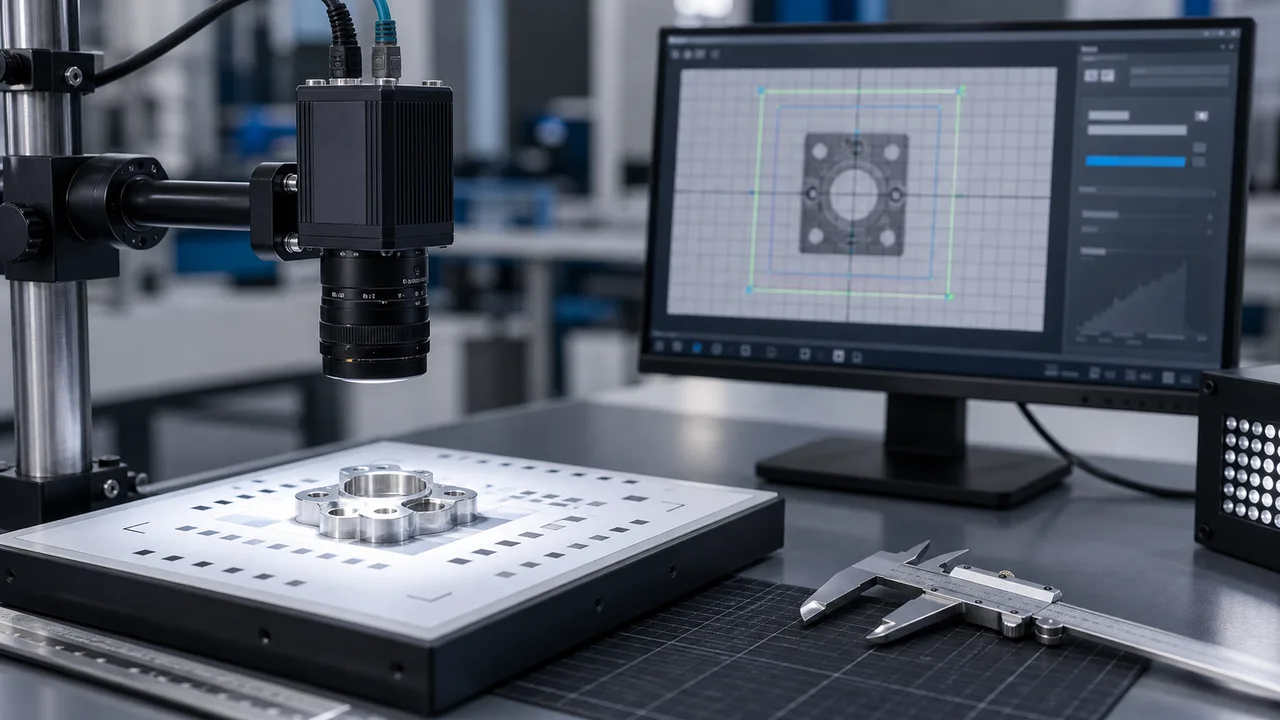
Machine vision camera resolution calculator bench with industrial camera calibration target pixel grid and precision part

Direct answer

Machine Vision Camera Resolution Calculator

Estimate machine vision camera resolution by dividing the required field of view by usable pixels, then checking whether the resulting pixel size can support the smallest feature, measurement tolerance and algorithm margin. Resolution is a starting calculation, not a guarantee of inspection stability.

Where this matters

Start with the inspection condition.

Calculate object-side pixel size first: FOV divided by usable pixels. Then verify lens resolution, lighting contrast, motion blur and tolerance margin before selecting the camera.

Why projects fail

Confirm the limits that change hardware.

Field of view drives pixel size.

RFQ preparation

Send enough context for a real review.

Resolution alone does not solve lighting or lens limits.

What engineering should check

What this page should help teams decide.

  • Start with the smallest feature or tolerance.
  • Field of view drives pixel size.
  • Resolution alone does not solve lighting or lens limits.
Practical note

Convert field of view into object-side pixel size.

If a 100mm field of view is captured across 2500 usable pixels, each pixel represents about 0.04mm on the part before lens and calibration effects. This quick calculation reveals whether a requested defect or tolerance is realistic.

Practical note

Detection and measurement need different margins.

A visible scratch may only need enough pixels to create contrast, while dimensional measurement needs repeatable edge position. For measurement, leave margin for lens distortion, threshold variation, fixture movement and calibration error.

Practical note

Lens and lighting can reduce usable resolution.

A high-megapixel camera does not help if the lens cannot resolve the feature, the aperture is wrong, the light creates glare or exposure causes blur. Optical and lighting tests should confirm the calculation.

Practical note

Frame rate and interface can cap practical resolution.

Higher resolution increases data volume. For moving parts, confirm exposure time, frame rate, trigger timing, interface bandwidth and processing load before quoting a larger sensor.

How to test before buying

Use this guide as a pre-RFQ decision filter, not as a part-number shortcut.

Machine vision selection is usually stable when the project starts from the inspection condition instead of a catalog model. Before requesting a quote, define what must be detected or measured, how the part moves, what surface behavior affects contrast and which factory constraint cannot change.

Use this guide to translate the requirement into testable inputs: sample images, target tolerance, line speed, field of view, working distance, mounting envelope and the current failure mode. That gives the factory enough evidence to map the request to camera, lighting, optics, reader or 3D routes.
Decision checks

Three checks before locking the route.

01

Presence or orientation

Requires enough pixels to separate part from background, usually less strict than measurement.

02

Small defect detection

Smallest defect should occupy enough pixels to remain visible after lighting and surface variation.

03

Dimensional measurement

Pixel size must be smaller than the required tolerance with calibration and edge-detection margin.

Decision table

Use these data points to turn the concept into an RFQ-ready decision.

Factor Practical rule RFQ impact
Presence or orientation Requires enough pixels to separate part from background, usually less strict than measurement. Send FOV, part size and required output.
Small defect detection Smallest defect should occupy enough pixels to remain visible after lighting and surface variation. Send defect size and good/bad sample images.
Dimensional measurement Pixel size must be smaller than the required tolerance with calibration and edge-detection margin. Send tolerance, gauge method and repeatability target.
Barcode or code reading Module size and code quality decide required pixels per module. Send code samples, size and read-rate requirement.
High-speed imaging Resolution must be balanced with exposure, frame rate and bandwidth. Send line speed, trigger method and interface constraints.

Application proof

Related delivery routes that make this selection decision concrete.

View all cases

Common mistakes

Problems that slow down selection.

  • Selecting by model number before the inspection target is measurable.
  • Treating lighting as an accessory instead of the main contrast-control tool.
  • Ignoring fixture stability, part variation and operator maintenance workflow.

Factory handoff

What Deyi Vision reviews after receiving the project details.

The factory route review starts by checking whether the image can be made stable with lighting and fixture control. Then the camera, lens, reader or 3D sensor route is sized against speed, resolution, interface and installation constraints.

If you already have a Keyence, Cognex, Basler, OPT, LMI, Hikrobot or barcode-reader reference, include it as a reference model. Deyi Vision uses it to understand the application class; final selection still depends on real samples and production limits.

Guide to RFQ

Have a real part, sample image or production constraint?

Use the guide to frame the question, then send the details so engineering can recommend a route.

Request engineering RFQ

Guide FAQ

Questions related to machine vision camera resolution calculator.

Ask engineering
How do I calculate camera resolution for machine vision?

Start with required FOV and smallest feature or tolerance. Divide FOV by usable sensor pixels to estimate object-side pixel size, then verify lens, lighting, speed and calibration margin.

Is a higher megapixel camera always better?

No. Higher resolution can reduce frame rate, increase processing load and expose lens or lighting limits. It is only better when the full imaging route can use the extra pixels.

What inputs are needed for a resolution recommendation?

Send field of view, smallest feature, measurement tolerance, working distance, part speed, lighting condition, lens constraints and sample images.

Contact

Direct RFQ contact

Talk to engineering about the inspection problem.

Send sample images, competitor model, FOV, working distance and line speed before model selection.

Target: selection brief within 24h
Send sample images