
When buyers compare this brand route.
OPT Lighting Alternative requests usually mean buyers need to confirm ring light, coaxial light, backlight and dome light rather than choose one fixed replacement model.
Alternative selection guide
Select machine vision lighting by part surface, defect type, contrast method and mechanical installation constraints.
Deyi Vision is not affiliated with the compared brands. This page is for application-based selection and RFQ planning.
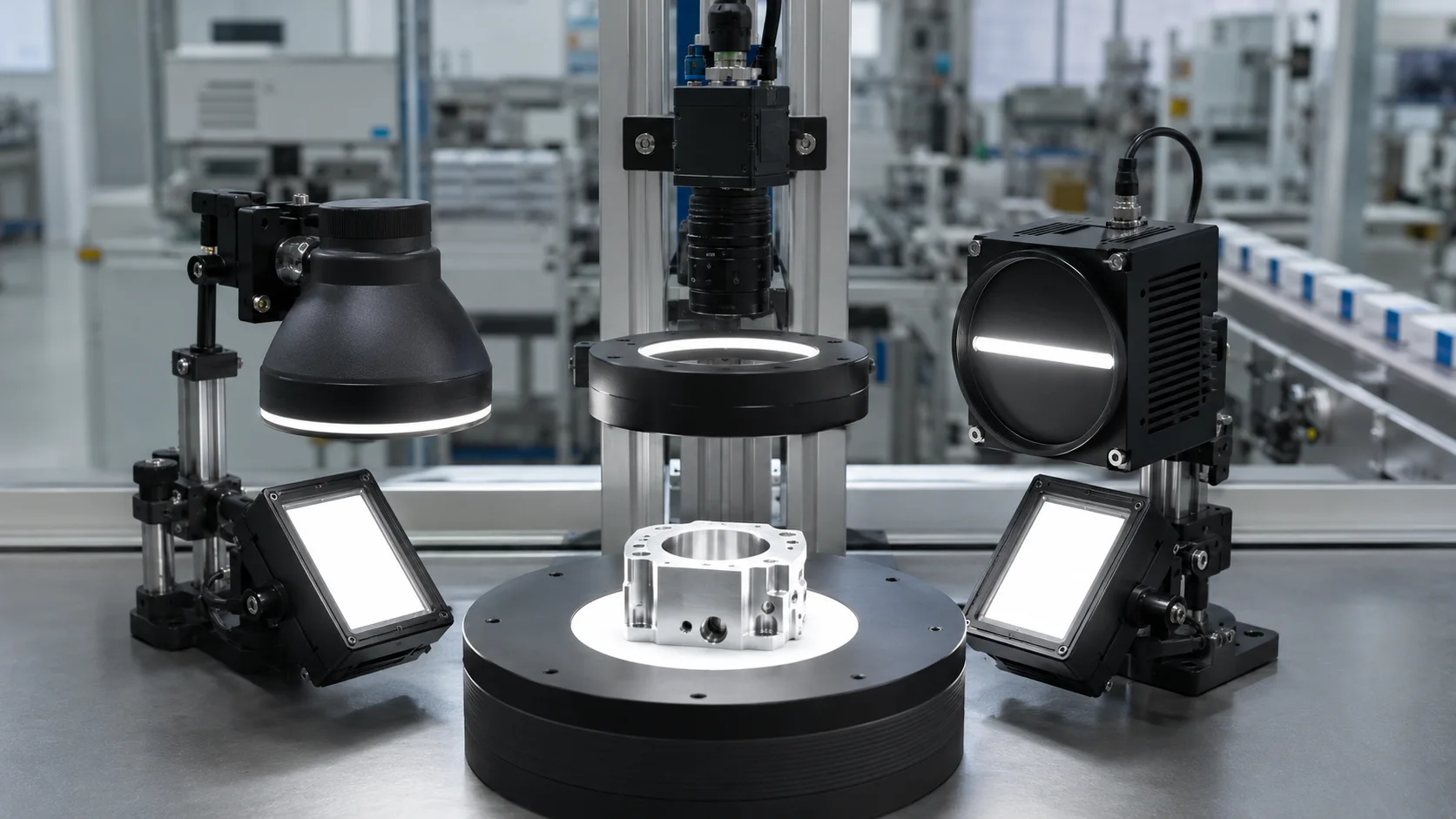
OPT Lighting Alternative requests usually mean buyers need to confirm ring light, coaxial light, backlight and dome light rather than choose one fixed replacement model.
Deyi Vision translates the reference into camera, lens, lighting, barcode reader, 3D or smart camera routes after reviewing sample images and production constraints.
Send current model, application photos, defect target, line speed, working distance, interface, trigger needs and budget constraints.
A comparison that cannot say this is an advertisement. These are the cases where the component route costs you more than it saves, and they are worth checking before you send an inquiry.
Comparison evidence boundary
Engineering comparison summary
Swipe horizontally to compare buyer question, Deyi route and evidence needed before quotation.
| Decision factor | Buyer question | Deyi answer | Evidence to send |
|---|---|---|---|
| Reference-model request | What does "OPT Lighting Alternative" usually need to confirm? | Compare 3 requirement groups: ring light, coaxial light, backlight and dome light. | Current model, target defect, sample images and why the current route is not enough. |
| Component route | Which hardware family should be reviewed first? | Start with Machine Vision Lighting, Machine Vision Lenses, Industrial 2D Cameras before asking for 1 fixed replacement model. | FOV, working distance, interface, line speed, trigger and mounting envelope. |
| Risk boundary | What should not be assumed from the brand name? | A brand reference does not prove lighting, optics, fixture, code-read angle, 3D height range or integration I/O. | Good/bad samples, worst-case surface, tolerance table and read-rate or repeatability target. |
| RFQ outcome | What should a useful reply contain? | Expect a route-level answer with 2-4 candidate component families, open constraints and validation steps. | Production photos, PLC/protocol needs, budget band, delivery country and acceptance criteria. |
Related selection guides
Choose machine vision lighting by surface finish, defect direction, camera angle, working distance and acceptance evidence instead of choosing by light shape alone.
ResourceCompare ring, bar, dome, coaxial, backlight and line lighting types by surface behavior, defect contrast and installation constraints.
ResourceSelect lighting for reflective metal scratch, burr and surface defect inspection by glare behavior, defect direction, camera angle and acceptance evidence.
ResourceA beginner-friendly guide to choosing machine vision lighting by contrast, surface behavior and defect type.
ResourceCompare backlight and coaxial machine vision lighting for silhouette measurement, flat reflective surfaces, printed marks and surface feature contrast.
Comparison RFQ
We will reply with the practical selection route, required constraints and questions to confirm before quoting.
Request engineering RFQComparison FAQ
No. Deyi Vision is not affiliated with OPT, and OPT is named only to describe the lighting function already installed. No light is automatically interchangeable. A similar ring, coaxial, dome or backlight housing can still produce a different image because the geometry, wavelength, coverage and drive mode differ. Treat any alternative as a new lighting configuration that must be validated on your own parts.
Keep it when the lighting geometry is already proven on the line and the parts pass. Changing a light changes the image, so the inspection then has to be re-validated. Also keep it when your build depends on OPT's published photometric data and colour consistency across several stations. An alternative cannot be assumed to match that data.
The light is one component in front of the camera and vision software, and that software still makes the OK/NG decision. A new light changes the image the decision is based on. Re-check the following at the same working distance, using good, bad and borderline samples: - contrast on the target defect - reflections and hotspots - uniformity across the field of view - exposure - any thresholds tuned to the old image If the existing decisions cannot be reproduced, do not switch.
Start from the part and the defect, not the brand. Work through these points in order: 1. Surface: shiny, matte, transparent or brushed. 2. Defect type and the contrast method that makes it visible. 3. The mechanical installation space. Backlight suits silhouettes and dimensional checks. Coaxial or dome light suits reflective surfaces. For scratches, set the angle and wavelength on real samples. Only after that, match the lens and camera.
| Model | Family | Parameter | Published value |
|---|---|---|---|
| DY-RS3475-W | Machine Vision Lighting | Power | 2W |
| DY-RS3475-W | Machine Vision Lighting | Light opening | 34mm outer / 10mm inner / 19mm height |
| DY-RS3475-W | Machine Vision Lighting | Color temperature | 6000-10000K |
| DY-FA0401C | Machine Vision Lenses | Focal length | 4mm |
| DY-FA0401C | Machine Vision Lenses | Sensor size | 1/1.8 inch |
| DY-FA0401C | Machine Vision Lenses | F.NO | 2.0-C |
| DY-GE307GM | Industrial 2D Cameras | Resolution / frame rate | 2048 x 1536 MAX @37FPS |
| DY-GE307GM | Industrial 2D Cameras | Effective pixels | 3MP |
| DY-GE307GM | Industrial 2D Cameras | Pixel size | 3.4 x 3.4um |