Application Guides

Food and Beverage Cap Label Date Code Inspection

Design food and beverage inspection for cap presence, label position, date code readability, fill or package checks, line speed and reject reliability.

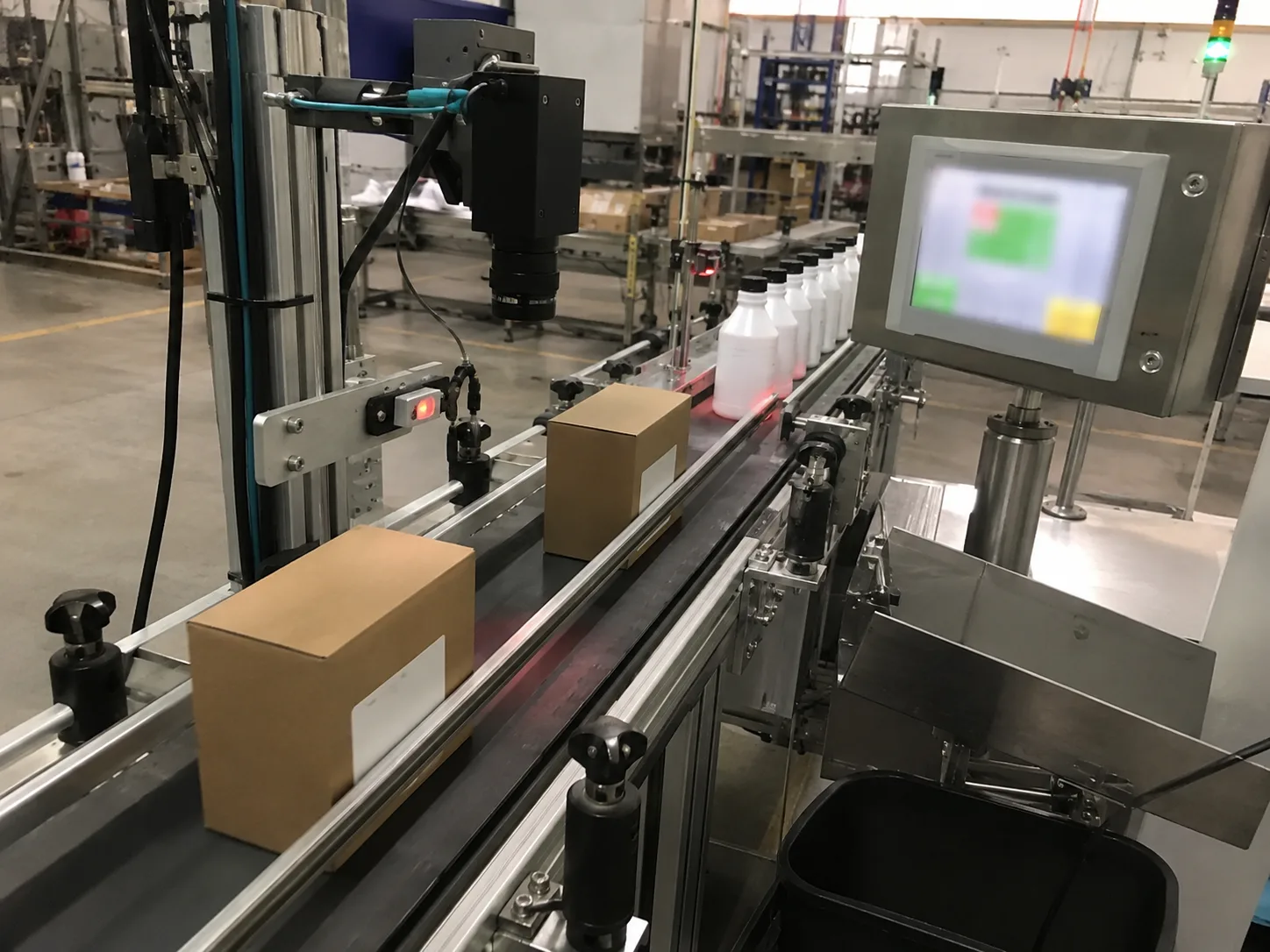
Food and beverage cap label and date code inspection line with smart camera and fixed reader

Direct answer

Food and Beverage Cap Label Date Code Inspection

Food and beverage vision inspection should separate 4 checks: cap presence, label position, date code readability and reject output. Confirm package shape, line speed, lighting washdown limits, code location and false reject target before choosing a smart camera or reader.

Quick answer

What is the short answer for food and beverage cap label date code inspection?

The inspection route should match the failure cost: missing caps, wrong labels, unreadable dates and failed rejects need different camera, light and output assumptions.

Quick answer

What should be confirmed before RFQ?

High-speed packaging needs trigger and reject timing defined early.

Quick answer

What evidence should Deyi Vision review?

Glossy bottles and wrap often need controlled lighting.

Key takeaways

What this page should help engineering teams decide.

  • Cap, label and date code checks need different evidence.
  • High-speed packaging needs trigger and reject timing defined early.
  • Glossy bottles and wrap often need controlled lighting.
Key point

Separate the inspection events.

A cap-present check, label-position check and printed date-code check are different vision problems. Combining them is possible, but the RFQ should state which outputs are mandatory and which are optional.

Key point

Packaging shape changes lighting and focus.

Cylindrical bottles, glossy labels, shrink film and transparent packaging can distort or reflect the target. Lighting, working distance and depth of field should be tested on real packages at production angle.

Key point

Date code readability is a traceability risk.

Inkjet and laser date codes can be low contrast, smeared or placed on curved surfaces. A smart camera or reader route should define OCR/OCV need, code location tolerance and no-read handling.

Key point

Reject timing protects the business result.

The station must reject or alarm at the right physical location. Line speed, trigger sensor position, processing time and reject distance should be confirmed before hardware is locked.

Selection framework

Use this guide as a pre-RFQ decision filter, not as a part-number shortcut.

Machine vision selection is usually stable when the project starts from the inspection condition instead of a catalog model. Before requesting a quote, define what must be detected or measured, how the part moves, what surface behavior affects contrast and which factory constraint cannot change.

For food and beverage cap label date code inspection, the engineering team should translate the requirement into testable inputs: sample images, target tolerance, line speed, field of view, working distance, mounting envelope and the current failure mode. That gives the factory enough evidence to map the request to camera, lighting, optics, reader or 3D routes.
Decision matrix

Three checks before locking the route.

01

Cap presence

Use a simple pass/fail route when cap geometry is visible and stable.

02

Label position

Use camera alignment checks when label skew or missing labels cause complaints.

03

Date code

Use OCR/OCV or code-reading route depending on print type and traceability need.

Comparison table

Use these data points to turn the concept into an RFQ-ready decision.

Factor Practical rule RFQ impact
Cap presence Use a simple pass/fail route when cap geometry is visible and stable. Send cap color, shape and line speed.
Label position Use camera alignment checks when label skew or missing labels cause complaints. Send allowed skew, offset and label material.
Date code Use OCR/OCV or code-reading route depending on print type and traceability need. Send code samples, placement tolerance and no-read workflow.
Reject output Match PLC timing to conveyor speed and reject distance. Prevents detecting defects without removing them.

Application proof

Related delivery routes that make this selection decision concrete.

View all cases

Common mistakes

Problems that slow down selection.

  • Selecting by model number before the inspection target is measurable.
  • Treating lighting as an accessory instead of the main contrast-control tool.
  • Ignoring fixture stability, part variation and operator maintenance workflow.

Factory handoff

What Deyi Vision reviews after receiving the project details.

The factory route review starts by checking whether the image can be made stable with lighting and fixture control. Then the camera, lens, reader or 3D sensor route is sized against speed, resolution, interface and installation constraints.

If you already have a Keyence, Cognex, Basler, OPT, LMI, Hikrobot or barcode-reader reference, include it as a benchmark. Deyi Vision uses the reference to understand the application class; final selection still depends on real samples and production limits.

Guide to RFQ

Have a real part, sample image or production constraint?

Use the guide to frame the question, then send the details so engineering can recommend a route.

Request engineering RFQ

Guide FAQ

Questions related to food and beverage cap label date code inspection.

Ask engineering
What can machine vision inspect on food and beverage lines?

It can inspect cap presence, label presence, label position, date codes, barcodes, fill or package presence and reject output depending on the line setup.

Why are date codes difficult to inspect?

Date codes can be low contrast, smeared, curved, reflective or placed in variable positions, so lighting and OCR/OCV route must be tested with real samples.

What should I send for a beverage inspection RFQ?

Send package photos, line speed, cap and label samples, date code examples, target defects, lighting limits, trigger and reject distance, and required output.

Contact

Direct RFQ contact

Talk to engineering about the inspection problem.

Send sample images, competitor model, FOV, working distance and line speed before model selection.

Target: selection brief within 24h
Catch Defects First