Basics

What Is a Smart Camera?

Decide when a smart camera is enough for a compact cell and when PC-based vision is safer for algorithms, data or multi-camera scope.

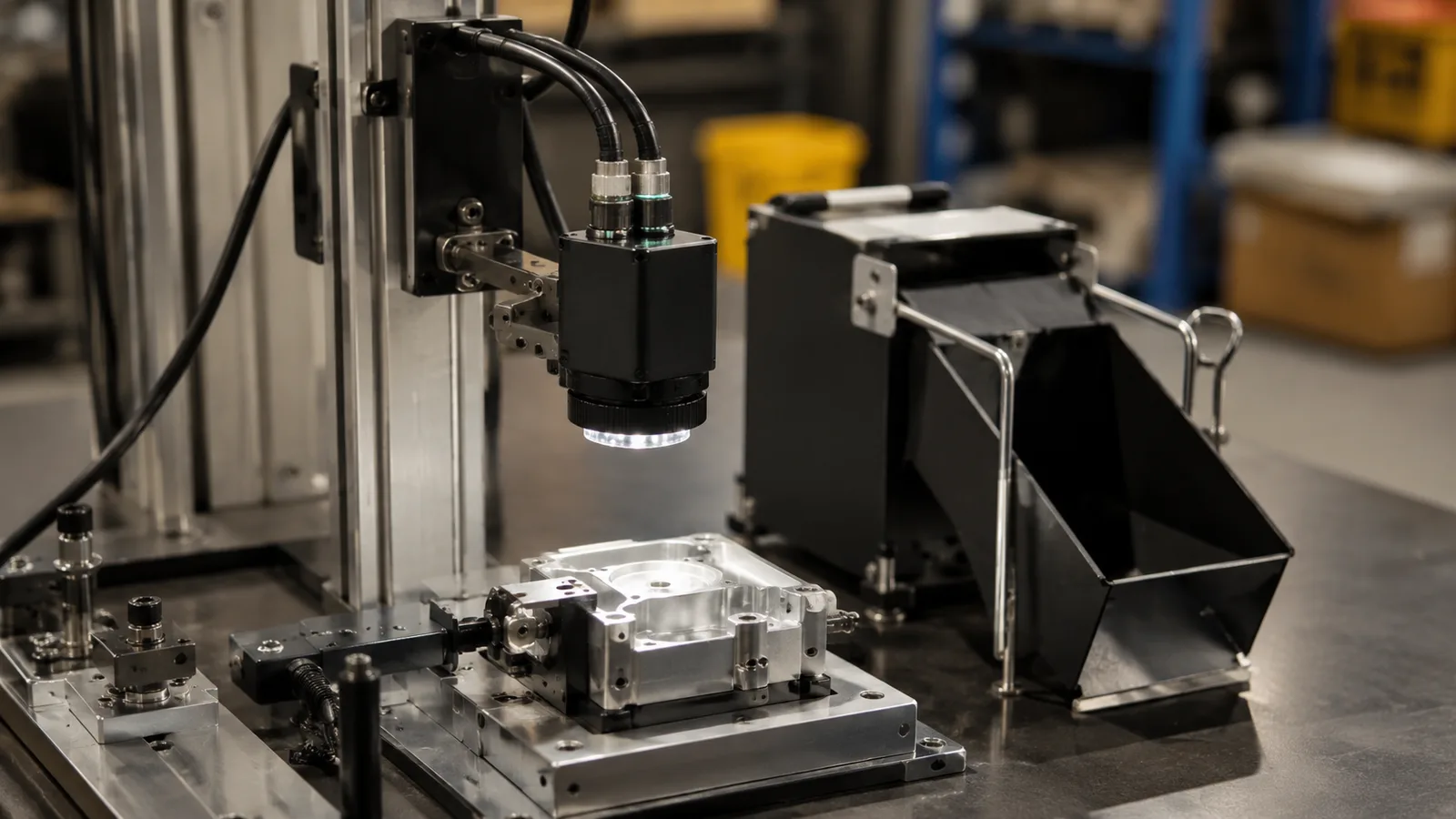
Smart camera product photo explaining onboard machine vision processing

Direct answer

What Is a Smart Camera?

A smart camera is useful when inspection logic is fixed, output is simple and the cell does not need a separate PC. It becomes risky when the project needs heavy processing, multiple cameras, custom algorithms or frequent recipe changes.

Where this matters

Smart cameras fit contained decisions at the edge.

A smart camera is useful when one station needs image capture, processing and I/O in one compact device, such as presence, orientation, label, code or simple measurement checks.

Why projects fail

Smart-camera projects fail when system scope is underestimated.

If the inspection needs multiple synchronized cameras, heavy image storage, custom algorithms or database workflows, a PC-based route is usually safer than forcing all logic into one camera.

RFQ preparation

Send the I/O and maintenance context.

Provide trigger method, PLC or protocol needs, reject output, operator interface, recipe-change workflow, FOV, speed and sample images before choosing a smart camera.

What engineering should check

What this page should help teams decide.

  • Smart cameras combine image capture and processing in one compact device.
  • They fit contained pass/fail, presence, code and simple measurement tasks.
  • PC-based vision is safer for multi-camera or algorithm-heavy projects.
Practical note

Smart cameras reduce system footprint.

A smart camera contains sensor, processor, software tools and I/O in 1 device, which can simplify compact stations and retrofit projects.

Practical note

Contained inspections are the best fit.

Presence, orientation, label, code support and simple pass/fail decisions are easier to maintain when one operator can understand the recipe, I/O status and reject reason at the station.

Practical note

Do not force complex cells into one device.

Multiple synchronized cameras, heavy image logging, custom algorithms, database workflows or advanced robot guidance usually need PC/controller architecture rather than a single smart camera.

How to test before buying

Prove the cell can be maintained without a PC.

Test good, bad and borderline samples, then ask who changes recipes, backs up settings and recovers after a no-read or false reject. Smart-camera fit depends on maintainability as much as image quality.

Decision checks

Three checks before locking the route.

01

Smart camera

Best for 1-camera compact pass/fail tasks.

02

PC-based vision

Better for 2+ cameras, heavy processing or complex coordination.

03

Maintenance

Smart cameras can be easier for line-side teams.

Decision table

Use these data points to turn the concept into an RFQ-ready decision.

Factor Practical rule RFQ impact
Smart camera Best for 1-camera compact pass/fail tasks. Send I/O and operator maintenance needs.
PC-based vision Better for 2+ cameras, heavy processing or complex coordination. Send camera count and software requirements.
Maintenance Smart cameras can be easier for line-side teams. Confirm who will adjust recipes and backups.

Application proof

Related delivery routes that make this selection decision concrete.

View all cases

Common mistakes

Problems that slow down selection.

  • Using a smart camera for a multi-camera or algorithm-heavy system that needs PC-level control.
  • Ignoring I/O, trigger, recipe backup and operator maintenance before model selection.
  • Assuming onboard tools can solve weak contrast without sample-image validation.

Factory handoff

What Deyi Vision reviews after receiving the project details.

The factory route review starts by checking whether the image can be made stable with lighting and fixture control. Then the camera, lens, reader or 3D sensor route is sized against speed, resolution, interface and installation constraints.

If you already have a Keyence, Cognex, Basler, OPT, LMI, Hikrobot or barcode-reader reference, include it as a reference model. Deyi Vision uses it to understand the application class; final selection still depends on real samples and production limits.

Guide to RFQ

Have a real part, sample image or production constraint?

Use the guide to frame the question, then send the details so engineering can recommend a route.

Request engineering RFQ

Guide FAQ

Questions related to what is a smart camera?.

Ask engineering
What is a smart camera in machine vision?

A smart camera is a compact vision device that combines image capture, onboard processing and I/O so it can make inspection decisions without a separate PC.

When is a smart camera better than a PC-based vision system?

It is better for contained single-camera inspections where the logic, I/O and maintenance needs are simple.

When should I avoid a smart camera?

Avoid it when the project needs multiple synchronized cameras, heavy image processing, large data storage or complex custom software.

Contact

Direct RFQ contact

Talk to engineering about the inspection problem.

Send sample images, competitor model, FOV, working distance and line speed before model selection.

Target: selection brief within 24h
Send sample images